Why Dark Fantasy Heroes Maintain Their Humanity

Discover why morality is essential in dark fantasy. Explore how characters like Soren in Guild of Assassins maintain their humanity despite walking dark paths, and why moral boundaries make these heroes relatable and compelling.

The best dark fantasy understands that even in shadow, some lights still flicker.

Characters who deal death, who walk morally grey paths, who compromise their principles – they still carry fragments of their original humanity.

These remnants often manifest not in what they do, but in what they refuse to do.

Soren’s Moral Anchors in Guild of Assassins

My novel Guild of Assassins explores this idea through Soren’s transformation.

Though circumstances force him to become a killer, to master arts of death, to participate in the brutal Threshing, he maintains certain lines he won’t cross.

His loyalty to Alaric, his rejection of Kierak’s needless cruelty, his struggle to retain something of his sculptor’s soul – these aren’t just character traits but anchors keeping him from completely losing himself.

The Cost of Holding Moral Lines

What makes these moral lines compelling isn’t their existence but their cost.

When Soren and Alaric maintain their friendship despite the guild’s pressure to compete, when they stand together during the Threshing rather than turn on each other, their choices matter precisely because they’re made against self-interest.

Like the best dark fantasy characters, their humanity shows most clearly when preserving it demands sacrifice.

Training as a Test of Morality

The training sequences particularly highlight this dynamic.

Each master represents a different flavour of moral compromise – Varus’s brutality, Tamasin’s poisonous arts, Quillon’s clinical detachment, Elysia’s manipulation.

Yet through their lessons, we see how students can master dark skills while refusing to completely surrender to darkness.

Technical capability doesn’t demand total corruption.

Humanity Through Small Resistances

This reflects something true about human nature – that morality often manifests not in grand gestures but in small resistances.

When Soren refuses to embrace Kierak’s sadistic philosophy, when he kills during the Threshing from necessity rather than pleasure, these subtle distinctions become powerful markers of retained humanity.

Morality Within the Guild’s Structure

Even the guild itself inadvertently highlights how moral lines persist in darkness.

Its elaborate codes, its complex traditions, its ritualised violence – these suggest that even professional killers need structure, limits, meaning.

Like the best dark fantasy institutions, it shows how organisations built on darkness still create their own form of ethics.

The Adaptability of Moral Compasses

Perhaps most powerfully, these stories show how moral compasses can adapt without completely breaking.

When Soren becomes capable of killing, when he masters deception and manipulation, his values don’t vanish but evolve.

He develops a harder code – one that accepts necessity while rejecting needless cruelty.

Like the best dark fantasy characters, his morality becomes more complex rather than simply corrupted.

Friendship as a Moral Anchor

The relationship between Soren and Alaric demonstrates how friendship itself can become a moral anchor.

Their loyalty to each other provides a fixed point, a reminder of who they were before darkness claimed them.

Through maintaining this connection despite everything trying to break it, they preserve something of their original humanity.

The Threshing: Morality as a Matter of Survival

The Threshing sequence crystallises this theme.

When Soren faces Kierak, their differing moral lines become literal matters of life and death.

Kierak’s embrace of cruelty versus Soren’s reluctant necessity, their different approaches to killing – these aren’t just character traits but fundamental choices about retaining humanity in darkness.

Morality as a Spectrum

This speaks to something profound about human nature – that morality isn’t binary but spectral.

Through characters like Soren, we explore how people can walk dark paths while maintaining internal lines they won’t cross.

Their complexity feels real precisely because it acknowledges both darkness and light.

The Burden of Preserving Humanity

Yet these stories don’t present preserved humanity as simple virtue.

Through Soren’s journey, we see how maintaining moral lines can become its own kind of burden.

Every choice to retain humanity, to refuse complete corruption, carries cost.

Like the best dark fantasy, it shows how even choosing light can demand sacrifice.

Why These Characters Resonate So Deeply

Maybe this is why these characters resonate so deeply.

They show us how humanity can persist even in darkness.

Through Soren’s struggles to maintain connection, to reject needless cruelty, to preserve something of his original self, we explore how people might walk dark paths without completely losing themselves.

Dark Fantasy’s Most Compelling Characters

In the end, dark fantasy’s most compelling characters aren’t those who simply embrace darkness or light, but those who navigate the shadows while maintaining personal lines they won’t cross.

Through characters like Soren, we examine how morality can adapt without breaking, how humanity can survive in darkness, how light can persist even in shadow.

Your Thoughts on Morality in Dark Fantasy

What moral lines do you think are most important for dark fantasy characters to maintain?

How do you think these choices define them?

Share your thoughts below.

Moral Ambiguity in Fantasy: Why Readers Love Complex Characters

xplore how moral ambiguity transforms fantasy storytelling. From complex characters like Soren in Guild of Assassins to relationships shaped by loyalty and betrayal, discover why readers are drawn to the grey areas between good and evil.

Remember when fantasy was simple?

Heroes wore white, villains wore black, and you could spot the evil one by their conveniently twisted features.

But modern readers crave something messier, more honest.

We want characters who live in the shadows between right and wrong, because that’s where real people dwell.

Soren’s Journey in Guild of Assassins

My novel Guild of Assassins illustrates this perfectly through Soren’s transformation.

He begins seeking justice for his father’s murder – a classic hero’s motivation.

But his path leads him to join an assassins’ guild, train in killing arts, and eventually participate in what amounts to ritualised murder during the Threshing.

Is he still a hero?

Was he ever?

The Appeal of Moral Complexity

This moral complexity hooks us because it reflects truth.

Most of us aren’t purely good or evil – we’re bundles of contradictions making compromises to survive.

When Soren learns to craft poisons from Tamasin or master manipulation from Elysia, we understand his choices even as we recoil from them.

His gradual corruption feels real precisely because it’s built on understandable decisions.

Antagonists Beyond Simple Categorisation

Even the story’s antagonists resist simple categorisation.

Kierak initially appears as a straightforward bully, but his brutality stems from the guild’s brutal culture.

The masters who train the recruits aren’t cackling villains – they’re professionals doing their jobs with varying degrees of cruelty and kindness.

Like real people, they contain multitudes.

The Rise of Moral Ambiguity in Modern Fantasy

This is why modern fantasy increasingly embraces moral ambiguity.

Look at George R.R. Martin’s work, where yesterday’s villain becomes tomorrow’s hero through shifting perspective.

Or Joe Abercrombie’s characters, who do horrible things for understandable reasons.

These stories resonate because they acknowledge that morality isn’t binary – it’s a spectrum we all navigate daily.

The Guild as a Symbol of Ambiguity

The guild itself represents this ambiguity perfectly.

It’s an organisation of professional killers, yes – but one with strict codes of conduct, formal training, and complex traditions.

Its members aren’t moustache-twirling villains but professionals practising a dark craft.

Like any real institution, it contains both corruption and honour, cruelty and loyalty.

Friendship in the Grey Areas

Soren and Alaric’s friendship demonstrates how moral ambiguity adds depth to relationships.

Their loyalty to each other is admirable, but it also enables their descent into darkness.

Are they saving each other’s humanity or helping each other lose it?

The answer isn’t clear because real relationships rarely have simple moral implications.

Revenge and Ambiguity

Even the revenge plotline gains complexity through moral ambiguity.

Soren’s quest for justice becomes increasingly hard to distinguish from simple vengeance.

Like the best morally grey narratives, it forces us to question not just the character’s choices but our own assumptions about right and wrong.

Training and Transformation

This complexity extends to the training sequences.

Each lesson learned, each skill mastered, carries both empowerment and corruption.

When Quillon teaches anatomy, is he sharing knowledge or teaching students to see humans as targets?

When Varus enforces discipline through violence, is he building strength or breaking humanity?

The answer is both – and that’s what makes it interesting.

Moral Ambiguity in Conflict

Moral ambiguity also creates better conflicts.

When Soren faces Kierak during the Threshing, it’s not a simple hero-versus-villain showdown.

It’s a clash between two people shaped by the same brutal system, each fighting for survival.

Their conflict matters precisely because neither is purely right or wrong.

Asking Deeper Questions

Perhaps most importantly, moral ambiguity allows fantasy to ask deeper questions.

Through Soren’s journey, we explore how survival demands compromise, how violence transforms its practitioners, how institutions shape morality.

These questions resonate because they don’t have easy answers.

The Rejection of Simple Narratives

This is why readers increasingly reject simple good-versus-evil narratives.

We know life is more complicated.

We want characters who reflect that complexity – characters who make mistakes, who compromise, who sometimes choose wrong for the right reasons and right for the wrong reasons.

Seeing Ourselves in Complex Characters

The best morally grey characters, like Soren, show us ourselves.

Their struggles with right and wrong mirror our own daily moral negotiations.

Their compromises feel familiar.

Their corruption becomes understandable, even as we hope we’d choose differently.

Embracing Complexity in Fantasy

In the end, moral ambiguity doesn’t weaken fantasy – it strengthens it.

By embracing complexity, stories like Guild of Assassins transform from simple adventure into nuanced exploration of human nature.

They remind us that the most interesting stories happen not in black and white, but in shades of grey.

Your Thoughts

How do you feel about moral ambiguity in fantasy?

Do you prefer clearly defined heroes and villains, or characters who blur the lines?

Share your thoughts below.

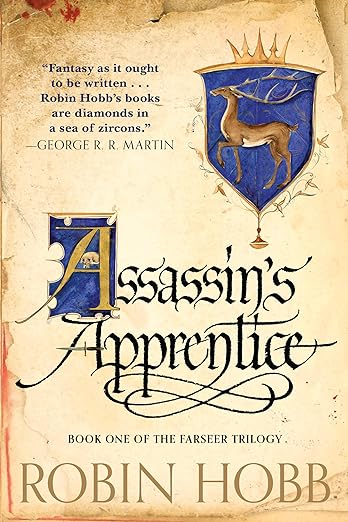
Exploring the Complex World of Robin Hobb’s Assassin’s Apprentice

Dive into Robin Hobb’s “Assassin’s Apprentice,” where fantasy meets complexity and morality blurs. Explore how FitzChivalry Farseer, an unlikely hero with a dark skill set, reshapes our understanding of fantasy protagonists. Unpack Hobb’s intricate world of magic and politics, delving into a narrative that goes beyond good vs. evil. Discover how this groundbreaking story influences modern fantasy, paving the way for deeper character development and more nuanced storytelling in the genre.

In the often bright and valiant world of fantasy literature, Robin Hobb‘s “Assassin’s Apprentice” arrived like a shadow in the night.

With this book, Hobb didn’t just introduce readers to a new story; she introduced us to FitzChivalry Farseer – a hero as unlikely as finding a courteous goblin.

This tale of an assassin’s apprentice was a sharp turn from the usual path of swords and sorcery, taking the road less travelled – and considerably darker.

An Assassin with a Heart: Shaking Up the Hero Mold

Fitz wasn’t your typical fantasy protagonist.

He was no noble knight on a gleaming steed nor a wise wizard with a long beard and a penchant for riddles.

Instead, he was a boy with a knack for killing and a complicated moral compass.

Hobb crafted a character that was as complex as he was conflicted, bringing a depth to Fitz that went beyond the traditional good versus evil narrative.

He was a walking contradiction, a hero in a role usually reserved for villains.

Magic and Mind: A Different Kind of Power

In “Assassin’s Apprentice”, magic wasn’t just about throwing fireballs or summoning storms.

Hobb introduced the Wit and the Skill – two forms of magic that were as nuanced as they were powerful.

The Wit, a bond with animals, was considered a lowly, almost taboo form of magic, while the Skill was a prestigious, mind-influencing ability.

This reimagining of magic systems injected a fresh dose of intrigue into the fantasy genre, turning magic into a source of inner turmoil as much as external power.

Narrative Grit: The Nitty-Gritty of Royal Politics

Hobb’s narrative delved deep into the murky waters of court intrigue and politics, with all the backstabbing and power plays one might expect in a den of vipers rather than a royal court.

This focus on the political, often from the perspective of someone usually left in the shadows, gave the fantasy genre a grittier, more realistic edge.

It was like lifting a rock to see the unsightly creatures writhing underneath – fascinating, if somewhat unsettling.

Influence on Modern Fantasy: The Echoes of Fitz’s Blade

The influence of “Assassin’s Apprentice” on modern fantasy is as clear as the scars on Fitz’s soul.

The series paved the way for a more nuanced approach to character development, where heroes were allowed to be flawed, and villains occasionally sympathetic.

Hobb’s blend of personal struggle, political intrigue, and a less conventional approach to magic has left an indelible mark on the genre, inspiring authors to explore the grey areas of their characters and worlds.

The Enduring Legacy of a Reluctant Assassin

“Assassin’s Apprentice” was more than just a fantasy novel; it was a masterclass in character-driven storytelling.

Robin Hobb created a world where the line between hero and villain was as thin as a knife’s edge, and just as sharp.

In the annals of fantasy literature, FitzChivalry Farseer remains a testament to the genre’s ability to evolve, to push boundaries, and to redefine what it means to be a hero.

The echoes of Fitz’s blade, and the choices he made with it, continue to resonate in the modern fantasy landscape.

Embracing the Morally Grey: A New Era in Fantasy Literature

Explore the rise of morally grey protagonists in fantasy literature, where characters challenge traditional notions of heroism. Delve into the world of complex, flawed heroes who reflect the nuanced realities of morality, shaping a new, more relatable and thrilling landscape in modern fantasy fiction.

Once upon a time in fantasy literature, heroes were as pure and straightforward as a glass of milk in a monastery.

Then came the rise of the morally grey protagonist, as welcome in the genre as a goblin at a fairy convention.

These characters brought a complexity to fantasy that was previously reserved for tax legislation, making the line between good and evil as blurry as a drunkard’s vision.

From White Knights to Grey Squires

Gone are the days when a hero’s armour shone brighter than their morals.

Modern fantasy has embraced protagonists who are less ‘knight in shining armour’ and more ‘person in mildly tarnished chainmail’.

These are characters who might save the world, but only after they’ve finished their pint and had a long think about whether the world is worth saving.

The Lure of the Grey

What is it about these morally ambiguous characters that captures our imagination?

Perhaps it’s their relatable nature.

After all, who among us is without sin, or at least a few parking tickets?

Or maybe it’s the unpredictability they bring to a story – a welcome reprieve from the good old days when you could predict a hero’s actions with the reliability of a train timetable.

Examples in the Wild

Take George R.R. Martin’s “A Song of Ice and Fire” series, where characters frequently change sides, and you’re never quite sure who to root for.

Or Joe Abercrombie’s “The First Law” trilogy, starring a barbarian with a conscience and a torturer with a heart.

These characters are as morally consistent as a politician’s promises.

The Appeal of the Dark Side

The rise of the morally grey protagonist also reflects a shift in societal norms.

In an age where we’re used to seeing heroes fall and villains rise on the evening news, these characters offer a mirror to our own world – albeit a slightly smudged one.

They remind us that life is rarely black and white, but an endless spectrum of greys.

Impact on the Genre

This new breed of protagonist has revolutionised fantasy literature, leading to richer, more complex narratives.

It’s an evolution from fairy tale simplicity to a genre that recognises the multifaceted nature of humanity.

And let’s face it, it’s just more fun to read about a hero who might save the princess or might just pawn her crown for a quick buck.

Long Live the Grey!

The rise of morally grey protagonists in fantasy literature marks a maturation of the genre.

These characters, with their complex motivations and questionable morals, offer a more nuanced exploration of the human condition.

They prove that sometimes, the most interesting path isn’t the high road or the low road, but the winding path that meanders somewhere in between.

In the end, isn’t that a bit like life itself?

Ten Reasons Why Fantasy Readers are the Best

Discover the ten reasons why fantasy readers are the best. From active imaginations to embracing moral dilemmas, explore the qualities that make them truly exceptional.

Fantasy readers are some of the most awesome people out there.

In this post, I will share ten reasons why fantasy readers are truly the best.

1. Fantasy readers have active imaginations and are able to fully immerse themselves in the worlds and stories they read.

2. They appreciate the creativity and originality that fantasy literature offers.

3. Fantasy readers are often open-minded and willing to suspend their disbelief in order to fully enjoy a story.

4. They appreciate the complexity and depth of the characters and worlds found in fantasy literature.

5. Fantasy readers tend to be voracious readers, always looking for their next great adventure.

6. They enjoy exploring different cultures, societies, and beliefs through the fantasy genre.

7. Fantasy readers tend to be well-read and well-versed in literature, often having a broad range of literary knowledge.

8. They appreciate the moral and ethical dilemmas that fantasy literature often explores.

9. Fantasy readers are often drawn to stories that deal with the struggle between good and evil, and the grey areas in between.

10. They enjoy stories that push the boundaries of what is possible and challenge their understanding of the world.

What do you think?