Fantasy’s love affair with assassins has come a long way from silent killers lurking in shadows.
Modern fantasy has transformed the archetype from simple dealer of death into something far more complex.
It’s now a lens through which we examine mortality, morality, and the price of power.
Guild of Assassins: A Perfect Example of Evolution
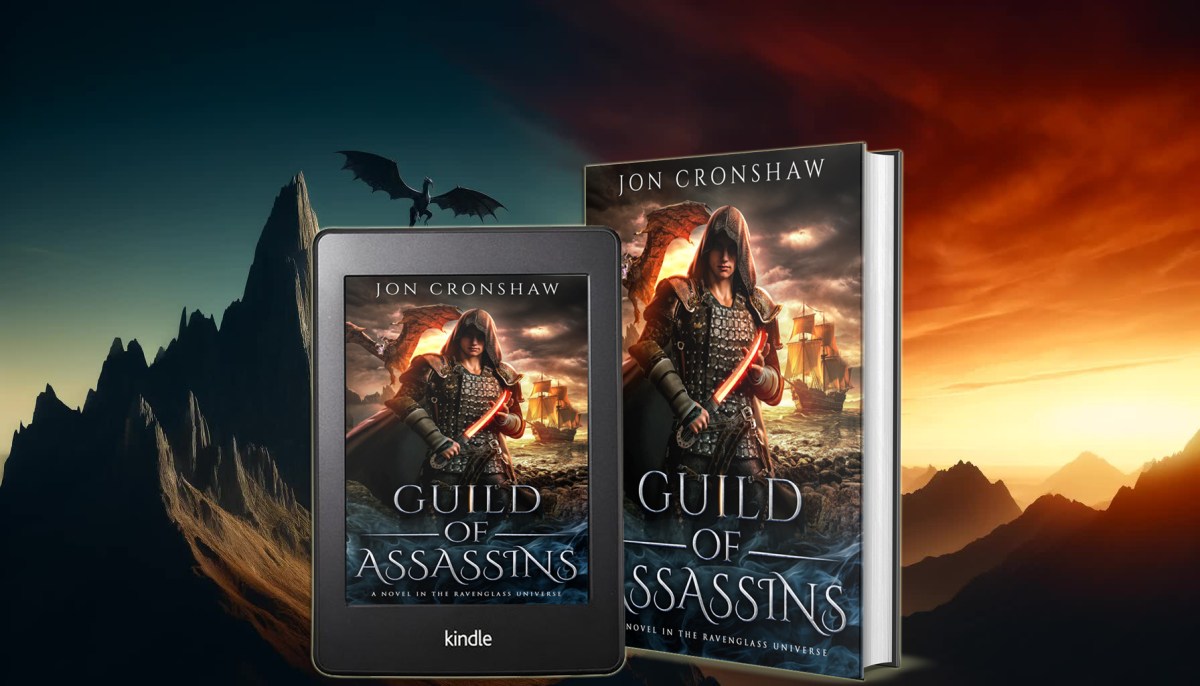
My novel Guild of Assassins represents this evolution perfectly.
When Soren enters the guild, he encounters not just killers, but professionals practising a dark craft.
Each master embodies different aspects of the trade.
Varus demonstrates martial prowess, Tamasin teaches the poisoner’s art, Quillon embodies clinical precision, and Elysia masters manipulation.
Like the best modern assassin fantasy, it presents killing as a multifaceted discipline requiring both physical and psychological transformation.
Shifting Away from Traditional Fantasy Assassins
This marks a significant shift from traditional fantasy assassins, who often relied on almost supernatural stealth and combat abilities.
Think of Fritz Leiber’s Gray Mouser or early D&D representations – assassins as merely thieves with deadly skills.
Modern fantasy recognises that killing is as much about psychology as it is about physical capability.
The Lineage of the Assassin Archetype
The evolution becomes clear when we trace the lineage of assassin characters.
Early works like Raymond E. Feist’s Assassin’s Apprentice began exploring the psychological toll of killing.
Brent Weeks’ Night Angel trilogy expanded this by examining how institutions shape killers.
Jay Kristoff’s Nevernight delved deep into the culture and philosophy of assassination.
Each iteration added layers of complexity to the archetype.
Assassins: Made, Not Born
Guild of Assassins continues this trend by focusing on how killers are made rather than born.
Through Soren’s training, we see how ordinary people become extraordinary killers through systematic breaking and rebuilding.
Each lesson strips away another piece of humanity while adding another lethal capability.
It’s a transformation that feels horrifyingly plausible.
Killing as a Transformation of Perception
Modern assassin fantasy also recognises that killing isn’t just about the act itself.
When Soren learns from Tamasin about poisons or studies manipulation with Elysia, he’s not just gaining skills.
He’s entering a different way of seeing the world.
Like the best contemporary takes on assassins, the story shows how the craft reshapes perception itself.
Complex Assassin Institutions
This complexity extends to institutions.
Gone are the days of lone killers operating in shadows.
Modern fantasy presents assassins’ guilds as complex organisations with their own cultures, traditions, and moral codes.
The guild in Guild of Assassins feels real precisely because it has bureaucracy, politics, and internal conflicts alongside its deadly arts.
Training Beyond Physical Skills
The training sequences particularly highlight this evolution.
Earlier fantasy might have focused purely on physical skills – weapon mastery, stealth, poison craft.
Modern takes recognise that creating killers requires psychological conditioning.
The guild doesn’t just teach Soren how to kill; it teaches him to see killing as natural.
Evolving Relationships Among Assassins
Relationships between assassins have evolved too.
Where once they might have been depicted as lone wolves, modern fantasy explores how killers form bonds.
Soren and Alaric’s friendship, the complex dynamics between recruits, and the master-apprentice relationships all show how human connections persist even in inhuman professions.
Exploring Deeper Themes Beyond Technique
Perhaps most significantly, modern assassin fantasy has moved beyond simple questions of technique to explore deeper themes.
Through Soren’s journey, we examine how violence transforms its practitioners.
We see how institutions normalise atrocity and how survival demands moral compromise.
The assassination becomes a metaphor rather than a mere plot device.
The Threshing: A Crucible for Transformation
The Threshing sequence demonstrates this perfectly.
It’s not just a test of killing skill but a crucible that forces characters to confront what they’ve become.
Like the best modern assassin fantasy, it uses violence to illuminate character rather than simply advance plot.
Broader Changes in Fantasy Literature
This evolution reflects broader changes in fantasy literature.
As the genre has matured, it’s moved from simple adventure stories to complex examinations of human nature.
Assassins have evolved from plot devices into vehicles for exploring fundamental questions about mortality, morality, and the human capacity for transformation.
The Primal Appeal of Assassin Stories
Yet something primal still draws us to assassin stories.
Perhaps because they embody both power and price – the ability to reshape reality through death, but only at the cost of one’s humanity.
Modern fantasy simply makes this exchange more explicit, more psychological, more real.
Guild of Assassins and the Future of Assassin Tropes
Guild of Assassins shows where the trope might go next.
Deeper into institutions, deeper into psychology, deeper into the fundamental questions of what it means to kill professionally.
It suggests that assassin fantasy’s evolution isn’t complete but is continuing into ever more complex territory.
Your Thoughts
How do you think assassin tropes in fantasy have changed over time?
Heroes wore white, villains wore black, and you could spot the evil one by their conveniently twisted features.
But modern readers crave something messier, more honest.
We want characters who live in the shadows between right and wrong, because that’s where real people dwell.
Soren’s Journey in Guild of Assassins
My novel Guild of Assassins illustrates this perfectly through Soren’s transformation.
He begins seeking justice for his father’s murder – a classic hero’s motivation.
But his path leads him to join an assassins’ guild, train in killing arts, and eventually participate in what amounts to ritualised murder during the Threshing.
Most of us aren’t purely good or evil – we’re bundles of contradictions making compromises to survive.
When Soren learns to craft poisons from Tamasin or master manipulation from Elysia, we understand his choices even as we recoil from them.
His gradual corruption feels real precisely because it’s built on understandable decisions.
Antagonists Beyond Simple Categorisation
Even the story’s antagonists resist simple categorisation.
Kierak initially appears as a straightforward bully, but his brutality stems from the guild’s brutal culture.
The masters who train the recruits aren’t cackling villains – they’re professionals doing their jobs with varying degrees of cruelty and kindness.
Like real people, they contain multitudes.
The Rise of Moral Ambiguity in Modern Fantasy
This is why modern fantasy increasingly embraces moral ambiguity.
Look at George R.R. Martin’s work, where yesterday’s villain becomes tomorrow’s hero through shifting perspective.
Or Joe Abercrombie’s characters, who do horrible things for understandable reasons.
These stories resonate because they acknowledge that morality isn’t binary – it’s a spectrum we all navigate daily.
The Guild as a Symbol of Ambiguity
The guild itself represents this ambiguity perfectly.
It’s an organisation of professional killers, yes – but one with strict codes of conduct, formal training, and complex traditions.
Its members aren’t moustache-twirling villains but professionals practising a dark craft.
Like any real institution, it contains both corruption and honour, cruelty and loyalty.
Friendship in the Grey Areas
Soren and Alaric’s friendship demonstrates how moral ambiguity adds depth to relationships.
Their loyalty to each other is admirable, but it also enables their descent into darkness.
Are they saving each other’s humanity or helping each other lose it?
The answer isn’t clear because real relationships rarely have simple moral implications.
Revenge and Ambiguity
Even the revenge plotline gains complexity through moral ambiguity.
Soren’s quest for justice becomes increasingly hard to distinguish from simple vengeance.
Like the best morally grey narratives, it forces us to question not just the character’s choices but our own assumptions about right and wrong.
Training and Transformation
This complexity extends to the training sequences.
Each lesson learned, each skill mastered, carries both empowerment and corruption.
When Quillon teaches anatomy, is he sharing knowledge or teaching students to see humans as targets?
When Varus enforces discipline through violence, is he building strength or breaking humanity?
The answer is both – and that’s what makes it interesting.
Moral Ambiguity in Conflict
Moral ambiguity also creates better conflicts.
When Soren faces Kierak during the Threshing, it’s not a simple hero-versus-villain showdown.
It’s a clash between two people shaped by the same brutal system, each fighting for survival.
Their conflict matters precisely because neither is purely right or wrong.
Asking Deeper Questions
Perhaps most importantly, moral ambiguity allows fantasy to ask deeper questions.
Through Soren’s journey, we explore how survival demands compromise, how violence transforms its practitioners, how institutions shape morality.
These questions resonate because they don’t have easy answers.
The Rejection of Simple Narratives
This is why readers increasingly reject simple good-versus-evil narratives.
We know life is more complicated.
We want characters who reflect that complexity – characters who make mistakes, who compromise, who sometimes choose wrong for the right reasons and right for the wrong reasons.
Seeing Ourselves in Complex Characters
The best morally grey characters, like Soren, show us ourselves.
Their struggles with right and wrong mirror our own daily moral negotiations.
Their compromises feel familiar.
Their corruption becomes understandable, even as we hope we’d choose differently.
Embracing Complexity in Fantasy
In the end, moral ambiguity doesn’t weaken fantasy – it strengthens it.
By embracing complexity, stories like Guild of Assassins transform from simple adventure into nuanced exploration of human nature.
They remind us that the most interesting stories happen not in black and white, but in shades of grey.
Your Thoughts
How do you feel about moral ambiguity in fantasy?
Do you prefer clearly defined heroes and villains, or characters who blur the lines?
Chapters 13 and 14 of Forged in Blood (Guild of Assassins, Book 2) are now live.
Episode 6 of Hunters, my space Western side project.
Episode 6 of Niamh’s Journey (Punks Versus Zombies side story).
For Free Members:
As the Gravity Flipped—a sci-fi story about a cleaner caught in a rebellion on a space station, now with an audio version available!
My weekly author diary video, offering insights into my writing process and updates.
Coming this weekend: The Mediocre Maverick, a satirical story you won’t want to miss.
Whether you’re a free or paid member, there’s plenty to enjoy this week. Thank you for your continued support and for being part of this creative journey!
For a limited time, you can download Guild of Assassins, the dark fantasy novel readers are calling “gritty, intense, and impossible to put down,” absolutely free on Kindle.
But hurry—this offer vanishes December 17.
In Guild of Assassins, you’ll meet Soren, a young sculptor turned trainee assassin, whose pursuit of vengeance takes him into the depths of a brutal guild.
As he uncovers secrets, faces deadly challenges, and questions his very humanity, one thing is certain—mercy has no place in the guild.
Grab your free copy now and begin your journey into the heart of darkness.
P.S. Can’t wait to continue the adventure? *Forged in Blood* (Book 2) is now available on Patreon. Use the promo code **RAVENGLASS** to get 50% off your first month on any tier. Visit: patreon.com/joncronshawauthor.
Quentin Coldwater enrols at Brakebills College for Magical Pedagogy, where the darker side of magic reveals itself in unexpected and often terrifying ways.
The students confront personal demons and the dangerous consequences of power in this gritty, subversive take on magical education.
Dark fantasy often shows us the worst of human nature.
Betrayal, violence, and corruption dominate the landscape.
Yet within these shadows, we find something profound: the bonds forged between broken people.
The ‘found family’ trope resonates not despite the darkness, but because of it.
Broken Characters Finding Strength Together
My novel Guild of Assassins explores this beautifully through its guild recruits.
Each arrives carrying their own wounds.
Soren with his murdered father.
Alaric torn from his fishing life.
Nia with her street survivor’s cynicism.
Isolde fleeing academic constraints.
Jareth haunted by lost nobility.
Alone, they’re vulnerable.
Together, they form something stronger than blood.
Bonds Tested Through Darkness
What makes these bonds compelling isn’t their initial formation but their testing.
When Kierak brutalises Soren, the others don’t just offer sympathy.
They risk themselves to help him reclaim his dagger.
When Jareth is injured by a trap, they carry him rather than abandon him as Ganrel suggests.
These moments matter because they’re choices made despite survival instincts, not because of them.
Loyalty Forming Against the Odds
The fascinating thing about found families in dark fantasy is how they form despite institutional pressure.
The guild tries to pit recruits against each other.
Yet bonds form anyway.
Like the Bridgeburners in Malazan Book of the Fallen or the Night’s Watch brothers in A Song of Ice and Fire, loyalty emerges precisely because the system demands its absence.
Brotherhood as Salvation and Burden
But these relationships aren’t simple.
When Soren and Alaric face the Threshing, their brotherhood becomes both salvation and burden.
Their loyalty keeps them human but also binds them to violence.
It’s reminiscent of how the Gentleman Bastards in Lynch’s series enable each other’s criminal lives while preserving each other’s humanity.
Shared Trauma as Bonding Agent
The training sequences reveal another aspect of found family – shared trauma as a bonding agent.
When recruits endure Varus’s brutality together.
When they learn killing arts from Quillon.
When they face Tamasin’s poisonous lessons.
They’re not just gaining skills.
They’re forming bonds through shared hardship.
Like soldiers in trenches, their brotherhood is forged in fire.
The Poisonous Side of Brotherhood
Yet dark fantasy recognises that found family isn’t always healthy.
Ganrel’s manipulation of group dynamics, his attempted exploitation of loyalties, shows how brotherhood can become poison.
The genre acknowledges that sometimes the family we choose can damage us as much as the one we’re born to.
Surviving Moral Transformation
What makes Guild of Assassins’ treatment of found family particularly compelling is how it shows these bonds surviving moral transformation.
When Soren becomes capable of killing.
When Alaric’s hands learn violence.
Their friendship adapts rather than breaks.
They accept each other’s darkness while helping each other retain fragments of light.
The Guild as a Dark Mirror of Family
The guild itself serves as a dark mirror of family structure.
The masters become twisted parent figures, dealing out both nurture and trauma.
Fellow recruits become siblings competing for approval while protecting each other from the worst abuses.
It’s a dysfunctional family, but family nonetheless.
Connection in Hostile Environments
Perhaps most powerfully, found family in dark fantasy shows how connection survives in the most hostile environments.
When the Threshing forces recruits to kill each other, previously forged bonds determine who lives and dies.
Loyalty proven through smaller moments pays off in ultimate tests.
Why We Love Brotherhood Bonds in Dark Fantasy
This is why we love brotherhood bonds in dark fantasy.
They show us how connection persists despite corruption.
How loyalty survives in darkness.
How family can be forged rather than just born.
Through characters like Soren and Alaric, we explore how shared darkness can create the strongest bonds.
The Double-Edged Nature of Brotherhood
Yet these stories don’t present found family as pure salvation.
They acknowledge how loyalty can enable destruction.
How brotherhood can perpetuate cycles of violence.
When Soren and Alaric face their final test, their bond saves them but also damns them to a killer’s path.
The Truth About Found Family in Dark Fantasy
Maybe that’s the ultimate truth about found family in dark fantasy – that it’s both salvation and burden.
Both light and shadow.
These bonds matter not because they’re perfect, but because they’re chosen despite imperfection.
Because they represent connection forged in darkness, loyalty tested by fire.
Your Thoughts
What are your favourite examples of found family in dark fantasy?
How do you think these bonds differ from similar relationships in lighter fantasy?
Exciting updates for both free and paid members this week!
For Paid Members:
Early access to Forged in Blood (Guild of Assassins, Book 2), with chapters seven and eight now available.
New chapters of Niamh’s Journey (Punks Versus Zombies side story).
A fresh chapter of Hunters, my fun space Western side project.
For Free Members:
The Speed of Boredom, a dark flash fiction piece about a young man convinced boredom is the secret to eternal life.
The Gibson Continuum, a cyberpunk-inspired short story.
At the moment, I’m posting four different chapters weekly, alongside a short story. Free members also receive regular updates, including short stories and author diary videos.
Paid subscriptions start at just $4.99 per month, so don’t miss out on all the exclusive content!
Blood, blades, and betrayal might draw readers to dark fantasy.
But it’s the quiet moments – the internal struggles, the fraying of conscience, the tested loyalties – that truly hook us.
When done right, character depth transforms dark fantasy from mere violence into a profound exploration of human nature.
Soren’s Transformation in Guild of Assassins
Consider how my novel Guild of Assassins handles Soren’s transformation.
Yes, there’s plenty of action – fights, assassinations, the brutal Threshing.
But the story’s real power lies in watching Soren grapple with what he’s becoming.
His hands, once devoted to creating beauty from stone, now deal death.
Each kill chips away at his humanity, like a chisel slowly revealing a darker form beneath.
The Cost of Vengeance
This internal conflict elevates the narrative beyond simple revenge.
We’re not just watching Soren learn to kill – we’re watching him struggle with the cost of vengeance.
When he finally confronts Kierak during the Threshing, the physical battle matters less than the psychological one.
Has Soren become the very thing he set out to destroy?
External Conflicts as Catalysts for Internal Struggles
The best dark fantasy recognises that external conflicts are merely catalysts for internal ones.
Mark Lawrence’s Prince of Thorns works not because Jorg is brutal, but because we understand the trauma driving his brutality.
Joe Abercrombie’s The Blade Itself captivates because Logen’s struggle with his berserker nature reveals universal truths about violence and identity.
Evolving Friendships Under Pressure
Character depth also transforms relationships.
Soren and Alaric’s friendship resonates because we see how their bond evolves under pressure.
Their loyalty isn’t just plot convenience – it’s repeatedly tested, questioned, and ultimately strengthened by their shared trauma.
Like Fitz and the Fool in Robin Hobb’s works, their relationship becomes more meaningful precisely because we understand its cost.
The Guild as More Than a Backdrop
The guild itself becomes more than just a backdrop for training montages.
Through Soren’s eyes, we see how each master embodies different aspects of the assassin’s craft.
Varus’s brutality, Tamasin’s poisonous wisdom, Quillon’s clinical detachment – they’re not just teachers but mirrors reflecting what Soren might become.
Depth in Secondary Characters
Even secondary characters gain depth through their struggles.
Nia’s street-smart cynicism masks deeper wounds.
Isolde’s scholarly precision reveals a need for control in a chaotic world.
Ganrel’s smooth manipulation hints at past betrayals.
Their interactions create a web of competing motivations far more compelling than simple plot mechanics.
Violence as Character Development
This emotional complexity makes the violence matter.
When Soren kills during the Threshing, it’s not just action – it’s character development.
Each death forces him to confront what he’s becoming.
The physical consequences pale compared to the psychological ones.
Like the best dark fantasy, the external violence serves to illuminate internal battles.
Moral Complexity Over Shock Value
The genre works best when it recognises that darkness isn’t just about blood and death – it’s about moral complexity.
Through Soren’s eyes, we explore how good intentions lead to atrocity, how survival demands compromise, how vengeance corrupts the vengeful.
These themes resonate because they’re grounded in character, not plot.
Beyond Grimdark: Character Depth in Dark Fantasy
grDark fantasy often gets dismissed as grimdark violence porn.
But stories like Guild of Assassins show how character depth transforms darkness from shock value into meaningful exploration of human nature.
Real darkness isn’t found in gore or body counts – it’s in watching characters we care about make impossible choices.
Why Character Depth Matters
This is why character-driven dark fantasy lingers with us.
Plot may drive the story forward, but character depth makes it matter.
When we understand Soren’s internal struggle, his external battles gain meaning.
His choices have weight because we feel the cost of each compromise, each lost piece of humanity.
Finding Hope Amid Darkness
Perhaps most importantly, character depth allows dark fantasy to explore hope amid darkness.
Through Soren and Alaric’s enduring friendship, through small acts of loyalty in a brutal world, we see how light persists even in shadow.
These moments of grace matter precisely because they’re earned through character development, not plot convenience.
The Real Battlefield: The Human Heart
In the end, the best dark fantasy recognises that true darkness isn’t found in violence but in the human heart.
Through deep characterisation, it transforms genre tropes into vehicles for exploring fundamental truths about human nature.
The magic and monsters serve only to illuminate the real battlefield – the one within.
Your Thoughts
How do you think character development enhances dark fantasy?
What are your favourite examples of character-driven dark fantasy?
Here’s what’s new for subscribers this week on my Patreon:
New for Members:
Forged in Blood (Guild of Assassins, Book 2) Chapters five and six are now available! Dive deeper into Soren’s journey as he trains within the Guild of Assassins, grappling with loyalty, betrayal, and the shadows of his past.
Niamh’s Journey (Punks Versus Zombies Side Story) The second chapter of this gripping tale is up. Follow Niamh and Sean as they navigate a zombie outbreak in Philadelphia, blending survival with heart-wrenching family drama.
Hunters (Wacky Space Western Side Project) The next chapter of Hunters is live. Join Dex, Kara, and Torin as they balance chaos and camaraderie on their space-faring escapades.
Free Content:
Even if you’re not a paying member, you can still enjoy some fantastic stories:
Lord Sidebottom and the Pirate Pandemonium Steampunk absurdity at its finest! Lord Sidebottom faces a pirate uprising with his usual mix of wit and Victorian manners.
The Speed of Boredom A bizarre flash fiction piece exploring the limits of ennui—or is it something more?
Membership Options:
Gain access to all these updates and more for just $4.99 per month. Plus, free members still enjoy regular updates!
Note: Apple has introduced a 30% surcharge for subscriptions made through the Patreon iPhone app. To avoid this extra cost, sign up via a browser instead. Your support is invaluable and keeps these stories coming!
To provide the best experiences, we use technologies like cookies to store and/or access device information. Consenting to these technologies will allow us to process data such as browsing behavior or unique IDs on this site. Not consenting or withdrawing consent, may adversely affect certain features and functions.
Functional
Always active
The technical storage or access is strictly necessary for the legitimate purpose of enabling the use of a specific service explicitly requested by the subscriber or user, or for the sole purpose of carrying out the transmission of a communication over an electronic communications network.
Preferences
The technical storage or access is necessary for the legitimate purpose of storing preferences that are not requested by the subscriber or user.
Statistics
The technical storage or access that is used exclusively for statistical purposes.The technical storage or access that is used exclusively for anonymous statistical purposes. Without a subpoena, voluntary compliance on the part of your Internet Service Provider, or additional records from a third party, information stored or retrieved for this purpose alone cannot usually be used to identify you.
Marketing
The technical storage or access is required to create user profiles to send advertising, or to track the user on a website or across several websites for similar marketing purposes.