
Top 10 Post-Apocalyptic Books to Read in 2024: The Ultimate Reading List

Explore the best of apocalyptic fiction with these 10 essential post-apocalyptic novels. From survival stories to gripping tales of the human condition, these books will keep you on the edge of your seat. Don’t miss out on this thrilling ride!

In the often bleak landscape of our future imaginations, post-apocalyptic novels hold a mirror up to society’s darkest fears and, occasionally, our bizarre optimism.

As the world teeters precariously on the brink of myriad potential disasters—climate change, nuclear war, a pandemic or two—it’s almost comforting to dive into a book where everything has already gone spectacularly wrong.

So, if you’re looking to explore the end of the world from the safety of your sofa, here are the top ten essential post-apocalyptic novels that offer a tour de force through desolation, despair, and the odd, indefatigable cockroach of hope that seems to survive every catastrophe.

So, whether you’re a die-hard fan of the genre or just looking for a new type of story to read, these books are guaranteed to be a thrilling ride.

“The Road” by Cormac McCarthy

In this Pulitzer Prize-winning novel, follow a father and his son on a bleak road trip through a world scrubbed clean by an unnamed catastrophe.

McCarthy paints a world so grim that even the sun is on sabbatical.

As they navigate through the ashy wasteland, scrounging for canned goods, dodging cannibals, and sharing moments that are as tender as they are harrowing, it’s clear that their bond is the only fire that won’t go out in this cold, dark setup.

“The Children of Men” by P.D. James

Imagine a world where the baby section in supermarkets is as redundant as a comb in a bald man’s pocket.

P.D. James thrusts us into this unsettling reality where human fertility has fizzled out and the last generation born is now grown up, leading to global despair and a peculiar nostalgia for diaper adverts.

The story centres around a disillusioned bureaucrat who finds himself caught in a tumultuous movement to overturn a despotic government while grappling with the existential dread of humanity’s endgame.

“The Walking Dead” by Robert Kirkman

In Kirkman’s world, zombies are as common as bad Wi-Fi signals, and just as annoying.

This gripping graphic novel series tracks a band of survivors who learn the hard way that the only thing worse than a zombie with a bad attitude is pretty much any living human with power.

It’s a narrative feast of blood, guts, and the human condition, served up with a side of “who’s going to betray the group next?”

“The Book of the Unnamed Midwife” by Meg Elison

After a plague has left the population thinner than a supermodel on a juice cleanse, a young woman finds herself traversing a barren America in “The Road to Nowhere.”

Armed with nothing but her wits and a pressing need to avoid becoming a disease statistic, she encounters enclaves of oddballs and outcasts who are redefining ‘strange new world.’

This journey isn’t just about survival but also about finding connection in the most disconnected of worlds.

“The Year of the Flood” by Margaret Atwood

In Atwood’s not-so-green garden of Eden, gene-spliced animals roam free, and humanity is the endangered species.

“The Year of the Flood” weaves together the lives of two women surviving in a biotechnological apocalypse, complete with cults, corporate overlords, and carnivorous rabbits.

It’s part environmental manifesto and part survival thriller, with a sprig of dark humour to remind us that, in the face of the apocalypse, you either have to laugh or cry—and crying wastes water.

“The Last Man” by Mary Shelley

Mary Shelley, not content with just birthing the science fiction genre with “Frankenstein,” decides to obliterate the human race with a plague in “The Last Man.”

Set in the late 21st century, this novel sweeps across a desolate world where our protagonist is left to pen history’s last diary entry.

As humanity coughs its way to oblivion, the narrative dives deep into solitude, despair, and the occasional existential crisis, offering a front-row seat to the end of the world show — spoiler alert, it’s not a sell-out crowd.

“The Postman” by David Brin

Imagine the post-apocalyptic world’s reliance on a hero, and you get… a postman.

David Brin’s “The Postman” revives the long-lost art of mail delivery in a future where the U.S. government has fewer members than a boy band.

Through the journey of a lone wanderer donning a postal uniform, the story delivers hope, stamped and sealed, to isolated communities.

In a world starved for communication, our postman hero proves that sometimes, all it takes to unite people is a bunch of old letters and an outdated job description.

“A Canticle for Leibowitz” by Walter M. Miller Jr

In the aftermath of a nuclear apocalypse, where society has hit the ‘reset’ button all the way back to the Dark Ages, “A Canticle for Leibowitz” stitches together a narrative over centuries.

This tale marries monks with nuclear physics in a monastery dedicated to the preservation of scientific knowledge, led by the fictional patron saint of electricians, Saint Leibowitz.

Miller crafts a sardonic look at humanity’s penchant for self-destruction and history’s annoying habit of repeating itself, proving that no matter the era, people never really get tired of making the same mistakes.

“The Day of the Triffids” by John Wyndham

Just when you thought it was safe to stop worrying about the robot uprising, John Wyndham brings you mobile, carnivorous plants.

In “The Day of the Triffids,” the world is blindsided quite literally — most of humanity loses their sight overnight, and to add insult to injury, they must now contend with sentient plants with a taste for human flesh.

This novel serves up a thrilling tale of survival, where the hierarchy of Earth’s species is questioned, and humans might not be at the top of the food chain anymore.

It’s a botanical nightmare that’ll make you reconsider keeping potted plants in your home.

“Swan Song” by Robert McCammon

Following a nuclear war that turns America into a wasteland, “Swan Song” by Robert McCammon tells the epic saga of survivors who face not only the fallout but also the rise of supernatural forces.

As society crumbles, a young girl named Swan finds herself carrying the burden of possibly reviving hope for the world.

McCammon masterfully weaves a post-apocalyptic tapestry where the battle for good and evil gets murkier by the page, and every survivor’s tale is a heavy blend of horror, heroism, and a hint of magic.

In this grim new world, the quest for survival might just depend on a child who has the power to grow plants in a land where nature has been scorched away.

“The Wasteland” series by Jon Cronshaw
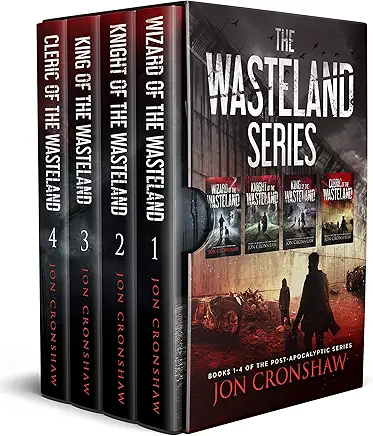
Abel survived the apocalypse…

…but drugs nearly killed him.


He scrapes together a meagre existence with his dog trading junk he finds on the wastes.

But when he crosses paths with a group of enslaved children, he must do everything he can to save them.

Can he ever be free from drugs?

Will he find a place to call home?

Is there hope in a hopeless world?

This collection brings together all four novels in Jon Cronshaw’s Wasteland series.

You’ll love these books because everyone loves post-apocalyptic survival, flawed heroes, and tales of good versus evil.


While our tour through the ashes of civilisations might not be the cheeriest journey you’ll undertake, these top ten post-apocalyptic novels provide profound insights into the human spirit.

They remind us that even at the end of the world, there can be beginnings.

So, whether you’re into the chilling echoes of silent cities, the thrill of dystopian survival, or just a glimpse into what might await after the apocalypse, there’s a book here to satisfy that morbid curiosity.

Keep the lights on, stock up on canned goods, and happy reading—just in case.

Magic on the High Seas: Exploring the Genre of Nautical Fantasy

Dive into the depths of nautical fantasy novels; their rich world-building, maritime myths, and captivating seafaring adventures await exploration.

Fancy yourself an adventure? A swashbuckling escape from terra firma into a world of monsters, pirates, and unsolved mysteries of the uncharted deep?

Perhaps it’s time to dip your toes into the ocean of nautical fantasy novels, a genre that unites the thrill of the high seas with the enchantment of the fantastical.

Whether it’s a towering ship cresting a colossal wave or a haunted seafarer whispering tales of ghostly apparitions, there’s an undeniably magnetic pull to stories of the sea.

And when these tales are woven with elements of the fantastic, well, that’s when the magic really happens.

A Change of Scenery

Fantasy novels often have a reputation for taking place in a quasi-medieval setting—think rolling green fields, stony castles, and bustling village markets.

Nautical fantasy, however, tosses that familiarity overboard.

 Instead, we’re introduced to the vast and uncharted waters of the ocean, and a ship that serves not only as transport but as a character in itself.

The sea is an arena of the unknown, where anything can happen.

Variety in Lore and World-Building

Nautical fantasy taps into a rich seam of mythology and folklore.

From the Kraken of Scandinavian legends to the mermaids of global folk tales, the sea is a hotbed of mythical creatures.

Furthermore, different cultures around the world have unique relationships with the sea, leading to a vast array of seafaring tales and traditions.

This variety is reflected in nautical fantasy, leading to a wealth of world-building opportunities.

Life on the Edge

There’s a thrill to stories set in precarious environments.

And what’s more precarious than a wooden ship bobbing on the whims of the tempestuous sea?

Stories of survival, endurance, and the battle against the elements are commonplace in nautical tales.

These scenarios crank up the tension and keep the reader turning pages.

The Promise of Discovery

The sea is a realm of discovery.

In real-world history, brave (or foolhardy) explorers crossed oceans in search of new lands, cultures, and riches.

In nautical fantasy, these voyages of discovery often have an extra layer of excitement, unveiling new magical systems, mythical creatures, or ancient civilisations.

Piracy, Freedom, and Rebellion

There’s a reason we’re captivated by the romantic image of the pirate.

 The figure of the buccaneer embodies a sense of freedom, rebellion, and non-conformity that’s hard to resist.

And with that comes the tantalising promise of treasure, adventure, and high-seas skulduggery.

Just try to ignore the reality of their brutal existence and it’s all fun and games.

 Themes of Deep Resonance

The sea is an excellent backdrop for themes of introspection and transformation.

Characters at sea have time to ponder their existence, wrestle with inner demons, or discover hidden depths to their personality.

The journey often becomes as much about inner change as it is about physical travel.

In short, nautical fantasy gives us a splash of the familiar and a hefty dose of the unknown.

It provides a stage for the fantastical to intermingle with historical influences, leading to stories that can be fun, introspective, terrifying, and always deeply captivating.

So, if you’re craving a change from the kingdoms and wizards of typical fantasy, grab a nautical fantasy novel.

Let the salty sea air fill your lungs, feel the sway of the deck beneath your feet, and set sail for adventure.

Wizard of the Wasteland – chapter one (excerpt)

Experience the gripping post-apocalyptic world of Jon Cronshaw’s “Wizard of the Wasteland” in the first chapter reveal. Join Abel as he fights for survival, battles addiction, and encounters enslaved children. Discover a world of hope and despair in this thrilling sci-fi novel.

Wizard of the Wasteland by Jon Cronshaw

The stranger rolled into town at dawn, his cart rumbling through the gap in Trinity’s towering fence.

Abel squinted at the sun’s orange glare as it rose over the rooftops. “Come on, Pip.” He patted his thigh as a brindle-furred dog looked up at him and ran in a tight circle, her tail wagging. He passed huddled shacks as people gravitated towards the arrival.

Abel followed the gently sloping dirt track towards the entrance as Pip trotted at his side. Trinity wasn’t his home, but they always gave him a bed and meal when he came to trade.

Chickens darted in haphazard zigzags, confined by a line of wire mesh to his right, shedding feathers as they avoided the dog. The looming crucifix beyond the fence spread shadows across the rooftops. Children ducked past him, laughing as they chased each other.

A brown and grey mule lumbered forward, its head bowed as its rider brought the cart to a halt. The cart rocked on four rubber tyres. Garish daubs of blue and gold paint stretched along its sides.

Engulfed by dusty blue robes, the man dropped from the cart, reached behind his seat, and pulled on a pointy blue hat. He turned to the residents. “Ladies and gentlemen. I am the Great Alfonso, Wizard of the Wasteland.”

Abel joined the edge of the crowd as Pip sniffed around behind him, unconcerned by the wizard. Pip had been with him since he got off plez. She was the best reason he had to stay clean.

People stepped aside for Trinity’s priestess, Sal, as she moved through the crowd to speak to the wizard, her dreadlocks hanging loose from her hooded robe.

The wizard offered her a grin. “My good lady, am I correct in assuming that you are the Sal these good people have been talking about?”

“That’s right.” She folded her arms. “And you are…?”

The wizard removed his hat with a flourish and bowed his head. His skin was darker than Sal’s, his hair an explosion of twisted curls, streaked in black and grey. He raised his yellow-tinged eyes to meet Sal’s gaze. “Madam, if you please, I am sure my reputation precedes me. I am the Wizard of the Wasteland.” He lifted his chin, offering her a toothy smile as he spread his arms wide. “I am the magnificent, the splendiferous, the incomparable, Great Alfonso.”

Sal shook her head, letting the silence hang in the air for a long, awkward moment. “Sorry, I’ve never heard of you.” She examined his cart, running a finger along the whorls of paint. “Are you a trader?”

“Yes, yes.” The wizard raised his voice and a finger. “But more.” He smiled again and swept his gaze across the gathered faces. “What I offer is the wonder of the Great Alfonso’s magical extravaganza.” He threw out his arms.

Abel smirked as a few titters spread behind him. What was this guy trying to pull? He’d seen his fair share of chancers and conmen, but this was something else.

“Magical what?” Sal tilted her head.

“What I have for you today, ladies and gentlemen, is the culmination of many years of tireless research into the arcane arts of magic and alchemy, a glimpse into our once great past, now long lost to dust.” The wizard grabbed a handful of soil and let it fall between his fingers.

“I still don’t understand.”

“My good lady, you strike me as an intelligent woman, which is why I will ask you to be my first volunteer.”

She looked around and shrugged. “Okay.”

The wizard shuffled around the side of his cart, unbolting a series of locks. An oak panel swung down on a pair of hinges, bouncing for a moment against its supporting ropes.

The onlookers moved in closer as the wizard arranged apparent junk along a series of shelves—an ancient television set with a curved grey screen and wood panel casing, a fish tank, and a hand generator in black and brass.

Abel raised his eyebrows at the objects, wondering where the wizard acquired them. The electrical items would be useless, but some of those things were worth a lot in trade.

The wizard lifted a toy car from the shelf, its red paint faded to a cloudy pink along its edges. He retrieved a key and made a show of pushing it into the car’s rear. “With this ancient and magical key, I can bring power to this otherwise inanimate object.” He placed the car flat on the panel and turned the key, the mechanism clicking and crunching. The wizard muttered an incantation, closed his eyes, and wriggled his fingers over the toy. He let go. The car shot forward and hurtled over the edge, landing in a clump of soft grass.

A few people applauded.

“Thank you, thank you. You are all most gracious.” He lowered his head and returned the car to its shelf. “What you’ve seen here is just a mere hint, a mere glimmer of the extent of my magical powers.”

He took something else down, turned to the crowd, and raised a pair of binoculars above his head. “Behold! These magical eye lenses allow their user to see objects that are far away as though they are right in front of their very eyes.” He handed the binoculars to Sal and showed her how to look through them, gesturing for her to point them towards the spherical form at the top of the water tower.

A hush dropped over the crowd as she looked through the lenses. “These are wonderful. Where did you find them?”

“That, madam, is a secret.” The wizard tapped his nose with a forefinger. “Please, pass those round. Let the other members of your wonderful community experience this glimpse into the possibilities of alchemy and magic. But, please, do be careful.”

People took turns looking through the lenses. Abel smiled at the gasps of awe and the occasional burst of laughter. When they reached him, he focused on the wizard rifling around one of the shelves. He looked down at a tug to his elbow.

A kid jumped up and down with eager excitement, clapping his hands and staring at the binoculars. He handed them to the boy, took a moment to show him how to use them, and turned his attention back to the wizard.

The wizard held up a light bulb. “As you will observe, this is a simple globe of glass. I would offer to hand this round so you can witness for yourself my ingenious design. But, because the magic is so powerful and so very dangerous, I will instead ask that you all take a few paces back to give me room to perform this most incredible and delicate of feats.”

He placed the light bulb on the panel and checked the wires were connected to the hand generator. He stepped over to the dynamo and muttered an incantation with a raised chin and half-closed eyes.

Smiling to the crowd, he wound the handle.

A low hum and sharp crackle of electricity emanated from the generator as he turned the handle.

A scattering of gasps spread around the wizard as the light bulb glowed a brownish-yellow.

“As you can see, with this ancient magic, I have created fire within this glass. I’m sure you will agree that this might be the most marvellous, magnificent, magical accomplishment you have ever had the good fortune to witness.”

He stopped abruptly, sweeping his gaze across the crowd, now rapt. He raised his right forefinger with a sudden jerk. “Oh, but there is more.” He made a dramatic turn, his robes billowing in an expanse of dusty blue.

The crowd moved forward with hesitant steps as they strained to get a closer look.

The wizard disconnected the wires from the light bulb, placed it in a pot filled with cloths on the middle shelf, and connected the wires to the television. He turned back to the crowd, spreading his arms wide. “I must ask again that you take a few steps back. This is very ancient and powerful magic. What I am about to show you is the most amazing sight. Where are the magical lenses?” He waited a few moments for the binoculars to return to him. He looked through them, smiled again, and placed them on a shelf. “With those lenses, you were able to make objects far away seem as though they were close enough to touch. Using the same principles, I have devised and constructed a magical box that allows you to see over great distances to lands to the west, beyond the lawless zone.”

He reached for the hand generator and cranked the handle again.

The belt hummed, crackling and sparking as the smell of burning rubber filled the air.

He leaned over to the television set, muttered a spell, pushed a button, and kept turning the handle.

White noise hissed from the television’s speaker as the screen came to life in a random array of white, black, and grey—a dead signal. “As you could see, ladies and gentlemen, what we are witnessing is a window into another land, another land shrouded in—what is it?” He tilted his head and rubbed his chin. “A dust storm, perhaps?” He dropped the handle and turned to the audience with a dramatic shrug.

The white noise fell to silence, the screen fading to black. The gathered crowd applauded as the wizard made a deep bow. “Thank you, thank you. You are all too kind.”

“What I am about to show you now may be my greatest miracle, the pinnacle of my magical achievements.” His expression turned grim. “I warn you all that this is ancient and powerful magic and urge you again to stand back.” He reached up to the fish tank on the top shelf and took it down, placing it carefully on the flat panel.

He pulled out a green frog, holding it up by one leg for the audience to see, its body squirming as its free leg flailed wildly.

Stepping over to Sal, he dangled the frog before her. “Madam, please do me the honour of telling the members of your wonderful community what you see before you.”

She glanced over her shoulder and shrugged. “It’s just a frog.”

“It’s just a frog! Never has a truer phrase been uttered. So you will agree that this is a living, breathing frog? You agree there is no trickery, no shenanigans? It is, as you say, ‘just a frog’?”

She nodded. “As I say, it’s just a frog.”

Without ceremony, the wizard swung the frog against the panel. He waited with his back to the crowd for several seconds and raised the lifeless body for all to see. “As you will observe, the life of this frog has been taken.”

He turned his attention back to Sal. “Madam, would you like to take a moment to examine this frog, to assure the ladies and gentlemen gathered that this is the same frog?”

“You killed one of God’s creatures. I wouldn’t call that magic.”

“And you would be correct in that most astute of observations.” He offered her a slight bow. “There is no magic in killing a frog, but as much as it pains me to do it, as much as it pains me to take the life of an innocent creature, it was unfortunately a necessary component of the Great Alfonso’s most important magical discovery.”

The crowd looked on in silence as the wizard laid the frog flat. He took the wires from the television, attached the crocodile clips to the frog’s torso, and muttered the words of a magic spell, making complex shapes and symbols in the air with his fingers.

He turned to the crowd, made a solemn expression, removed his hat, and bowed. “Observe.” His voice dropped to little more than a whisper.

He stepped over to the generator and turned the handle, building up a rhythm until the belt hummed again.

The frog’s right leg twitched. The wizard wound the handle faster, smiling when the frog convulsed, its arms and legs quivering spasmodically.

Dropping the handle, he placed his hat back on his head and turned to the audience. “As you have seen, ladies and gentlemen, the Great Alfonso has brought this frog back from the dead.”

He turned back to the frog, now limp, and dropped it into the fish tank. He faced the crowd, taking in the applause. “Thank you.”

A few men shook their heads and walked away.

Children ran over to the wizard, jumping up and down as they asked him questions.

The wizard closed his cart.

Abel smiled at the wizard and weaved through the crowd, making his way over to Sal. “What did you make of that?”

She sniffed. “He’s clearly a charlatan.”

“Yep. But he certainly knows how to put on a show.”

“It’s just technology from before the end times. There’s no magic to it.” Her eyes grew narrow as a few residents led the wizard’s mule away to be fed and watered.

“I know.” Abel rubbed his beard, trying to understand her hostility. “But you have to admit, it’s pretty fascinating stuff.”

A frown spread across her face. “You’re not seduced by this fraudster, are you?”

“No.” His protest came out more defensive than he would have liked. “I’m intrigued. It’s been a long time since I’ve seen anything with real electricity.”

Sal nodded. “Perhaps.”

A tall man with pale skin and dark hair wandered over.

Abel forced a smile. “Jacob.”

“You look healthy. I take it you’re still keeping clean?”

“Yep.” He bristled at the implication in Jacob’s tone. He’d been clean for over a year, but it was the same question every time he returned to Trinity. They were good people, and the settlement was the best place to trade this side of the Grid. “I’m just going about my business as usual. No plez for me.” He knelt next to Pip and rubbed the fur behind her neck. At least she never judged him.

“Good to hear. God willing, let’s hope you can stay that way.” One corner of his mouth twitched as he turned to Sal. “What’s the plan with our wizard friend?”

Sal shook her head and sighed. “I don’t know. The residents are clearly taken with him. Might cause friction if we ask him to leave.”

Jacob cast a cursory glance towards the wizard. “What do you say? We treat him like any other trader and hope he goes by the morning.”

“I don’t trust him.”

“Come on, Sal.” Abel gestured towards the fence. “It’s hard out there. He’s surviving. It’s different, I’ll grant you, but he’s not raiding, or dealing. He looks like he’s probably clean.”

She raised her hands. “You could be right. But, I still don’t like it. This promotion of magic and mysticism doesn’t sit well with me.”

Abel smirked. “Just a different kind of magic to what you’re used to. You’ve got God, this guy’s got…” His voice trailed off at Sal’s glare.

She turned to Jacob. “He can stay for breakfast, but then I want him gone.”