

In the often bright and valiant world of fantasy literature, Robin Hobb‘s “Assassin’s Apprentice” arrived like a shadow in the night.
With this book, Hobb didn’t just introduce readers to a new story; she introduced us to FitzChivalry Farseer – a hero as unlikely as finding a courteous goblin.
This tale of an assassin’s apprentice was a sharp turn from the usual path of swords and sorcery, taking the road less travelled – and considerably darker.
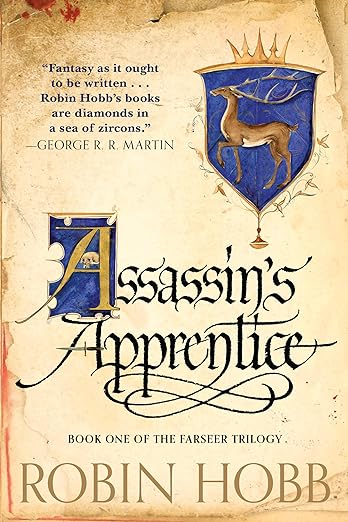
An Assassin with a Heart: Shaking Up the Hero Mold
Fitz wasn’t your typical fantasy protagonist.
He was no noble knight on a gleaming steed nor a wise wizard with a long beard and a penchant for riddles.
Instead, he was a boy with a knack for killing and a complicated moral compass.
Hobb crafted a character that was as complex as he was conflicted, bringing a depth to Fitz that went beyond the traditional good versus evil narrative.
He was a walking contradiction, a hero in a role usually reserved for villains.
Magic and Mind: A Different Kind of Power
In “Assassin’s Apprentice”, magic wasn’t just about throwing fireballs or summoning storms.
Hobb introduced the Wit and the Skill – two forms of magic that were as nuanced as they were powerful.
The Wit, a bond with animals, was considered a lowly, almost taboo form of magic, while the Skill was a prestigious, mind-influencing ability.
This reimagining of magic systems injected a fresh dose of intrigue into the fantasy genre, turning magic into a source of inner turmoil as much as external power.
Narrative Grit: The Nitty-Gritty of Royal Politics
Hobb’s narrative delved deep into the murky waters of court intrigue and politics, with all the backstabbing and power plays one might expect in a den of vipers rather than a royal court.
This focus on the political, often from the perspective of someone usually left in the shadows, gave the fantasy genre a grittier, more realistic edge.
It was like lifting a rock to see the unsightly creatures writhing underneath – fascinating, if somewhat unsettling.
Influence on Modern Fantasy: The Echoes of Fitz’s Blade
The influence of “Assassin’s Apprentice” on modern fantasy is as clear as the scars on Fitz’s soul.
The series paved the way for a more nuanced approach to character development, where heroes were allowed to be flawed, and villains occasionally sympathetic.
Hobb’s blend of personal struggle, political intrigue, and a less conventional approach to magic has left an indelible mark on the genre, inspiring authors to explore the grey areas of their characters and worlds.
The Enduring Legacy of a Reluctant Assassin
“Assassin’s Apprentice” was more than just a fantasy novel; it was a masterclass in character-driven storytelling.
Robin Hobb created a world where the line between hero and villain was as thin as a knife’s edge, and just as sharp.
In the annals of fantasy literature, FitzChivalry Farseer remains a testament to the genre’s ability to evolve, to push boundaries, and to redefine what it means to be a hero.
The echoes of Fitz’s blade, and the choices he made with it, continue to resonate in the modern fantasy landscape.
