Looking for fantasy novels where information is the battlefield? Discover five fantasy books about secrets, espionage, bureaucracy, political intrigue, and the struggle to control the truth.
Armies clash. Heroes fight villains. Kingdoms rise and fall.
But some of the most interesting fantasy novels I’ve read are about information.
Who controls it.
Who hides it.
Who gets to decide what’s true.
In these books, the decisive battles aren’t fought with swords. They’re fought with records, secrets, bureaucracy, manipulation, and the ability to shape what people believe.
If that sounds like your sort of thing, here are five books worth checking out.
This is probably the clearest example of what I’m talking about.
Baru comes from a conquered people and decides she’s going to destroy the empire that took her homeland.
The twist is that she doesn’t do it with an army.
She does it through administration. Tax policy. Economics. Bureaucracy.
It’s a novel where financial systems are weapons and accounting can be more dangerous than a sword.
What makes the book so compelling is the cost. To use the empire’s tools, Baru has to understand them. To understand them, she has to become part of them.
The result is one of the most devastating political fantasies I’ve ever read.
You could put several K. J. Parker novels on this list, but this is probably the easiest place to start.
The protagonist isn’t a great warrior or a chosen hero. He’s an engineer.
When a city comes under threat, he survives through logistics, planning, deception, and sheer nerve.
The joy of the novel is watching an intelligent person solve impossible problems.
The horror is realising how easily practical solutions can become moral compromises.
Parker understands better than almost anyone that institutions often run on paperwork, procedure, and people convincing themselves they’re being reasonable.
Abraham is interested in leverage rather than spectacle. Most of the important moments involve negotiations, agreements, obligations, and people understanding things their opponents don’t.
Very little is settled by violence.
Almost everything is settled by information.
What I love about Abraham’s work is that he never loses sight of the human cost. These aren’t abstract political manoeuvres. They’re choices that affect real people.
If you’ve read any of these books, I’d love to know what you thought of them.
And if you’ve got recommendations for fantasy novels where information, bureaucracy, espionage, or institutional power sit at the heart of the story, let me know. I’m always looking for more.
What happens when the paranoia, bureaucracy, and moral ambiguity of a John le Carré spy novel collide with epic fantasy? A look at fantasy espionage, institutional corruption, and the ideas behind Silent Watcher.
There’s a moment in a lot of epic fantasy where someone unrolls a map and explains the problem.
An ancient evil is rising. A kingdom is falling. A prophecy must be fulfilled. The lines are clear. The enemy is obvious.
John le Carré spent an entire career writing stories that work in exactly the opposite way.
Nobody unrolls a map because nobody can agree what the map means. The enemy isn’t a dark lord. It’s a department. A committee. A chain of decisions made by people who all believe they’re doing their jobs properly.
The hero isn’t chosen. They’re assigned.
Usually against their will.
And the great fear isn’t that evil will win. It’s that everyone involved has quietly stopped being able to tell the difference between winning and losing.
I’ve been thinking about that a lot while writing Silent Watcher, because fantasy rarely operates on those terms.
Fantasy is full of wars, rebellions, coups, and corrupt rulers.
Yet the genre is surprisingly trusting of institutions.
The rightful king returns. The true heir takes the throne. The wise order of mages was right all along. Even when institutions are corrupt, the corruption usually comes from somewhere else. A traitor. A dark influence. A villain who has infected an otherwise healthy system.
Remove the bad actor and everything works again.
Le Carré’s fiction runs on a different assumption.
The institution is the problem.
Not because a villain corrupted it.
Because the institution itself produces outcomes nobody would choose individually.
Everyone follows procedure.
Everyone acts reasonably.
Everyone passes responsibility to the next desk.
Then something terrible happens and nobody can point to the exact moment it became inevitable.
That’s a very different engine for a story.
One of the great strengths of a spy novel is uncertainty.
The protagonist always knows less than the people they’re investigating.
Every document could be planted.
Every witness could be rehearsed.
Every clue could have been left there deliberately.
The people creating the evidence are often the same people being investigated.
That translates remarkably well into fantasy if you build the institution correctly.
Imagine an order whose authority comes entirely from observation and record-keeping. Their reports become official history. Their archives become accepted truth.
Now imagine those records can be altered.
Reports disappear.
Names change.
Signatures appear on documents that were never signed.
Events are rewritten after they happen.
Suddenly the protagonist loses the one thing investigators normally rely on: certainty about the evidence.
That’s where the paranoia begins.
You don’t need magic to do this. Le Carré managed perfectly well with filing cabinets and classified documents.
Fantasy just gives you sharper tools.
The strongest influence le Carré had on me isn’t really about plot.
It’s about protagonists.
George Smiley isn’t an action hero.
His gift is attention.
He notices the inconsistency. The detail that’s slightly wrong. The explanation that’s a little too neat.
His heroism comes from refusing to look away.
Fantasy has an equivalent archetype, but we don’t use it very often.
The witness.
The observer.
The person whose job is not to fight, but to see.
And that’s where things become interesting.
Because what happens when a person trained to observe injustice realises that observation has become complicity?
What happens when faithfully recording events helps preserve a lie?
What happens when “watching without shaping” becomes an excuse for doing nothing?
Those feel like le Carré questions to me.
They’re also fantasy questions.
We just don’t ask them often enough.
So, why isn’t rthere more fantasy like this?
Part of the reason is that these stories are harder to sell.
The pleasures are quieter.
They’re built from suspicion, investigation, and revelation rather than spectacle.
As fantasy readers, we often expect a restoration at the end. The crown returns. The kingdom is saved.
A le Carré story isn’t usually interested in restoration.
It’s interested in asking whether the system was worth saving in the first place.
That doesn’t mean nobody is working in this space.
Seth Dickinson’s The Traitor Baru Cormorant is probably the clearest modern example. K. J. Parker spends a lot of time examining institutions through the lens of clever people trapped inside them. Robert Jackson Bennett and Daniel Abraham both understand that information and administration can be just as powerful as armies.
None of them are writing le Carré in a fantasy world.
But they’re all mining the same vein.
The one beneath the institution rather than the battlefield.
The one where the real horror isn’t the monster outside the walls.
It’s discovering the walls were built to keep you looking the wrong way.
If that sounds like your kind of fantasy, it’s very much the territory Silent Watcher occupies.
A Watcher arrives in a quiet provincial town to investigate a colleague’s death. The official record doesn’t match the evidence. Witnesses repeat the same stories. Documents vanish. Then she discovers reports carrying her own signature that she has no memory of writing.
It’s a standalone fantasy spy thriller for readers of Seth Dickinson, John le Carré, and K. J. Parker.
Divided Crown, Episode Seven of The Ravenglass Throne, continues the sweeping saga of three royal sisters fighting to hold a fractured kingdom together. War, betrayal, and forbidden power collide in this dark fantasy of wyvern-riders and royal intrigue.
Three sisters. One fractured kingdom. A crown that may not hold.
The princesses of Ostreich have never faced a greater trial.
War brews on every border. Whispered conspiracies erode the heart of their realm. Old loyalties are breaking faster than the throne they swore to protect.
Irmin, Adelinde, and Elana must each walk their own path—through betrayal, battle, and forbidden knowledge.
Each road promises power. Each choice carries a cost.
But divided strength cannot hold back what’s coming.
The sisters must decide: will they stand together—or let their kingdom fall apart forever?
A Dark, Sweeping Epic Continues
Divided Crown is Part Seven of The Ravenglass Throne, my ongoing epic of wyvern-riders, royal intrigue, and ancient conspiracies.
Across seven instalments, readers have followed the princesses as their father’s assassination plunged the kingdom into chaos. Now, their separate struggles collide in a story of war, betrayal, and impossible choices.
If you’ve been waiting for the next chapter—this is it.
And if you’re new to the series, this is the perfect time to begin your journey through Ostreich.
Why Readers Love The Ravenglass Throne
“A masterpiece of fantasy politics and family drama.”
“Every chapter leaves me desperate for the next.”
“Wyverns, betrayal, and sisterhood—what more could you want?”
Get Your Copy Today
Divided Crown is out now on KindleandKindle Unlimited..
Perfect for fans of The Priory of the Orange Tree and A Game of Thrones.
Political fantasy does more than entertain—it reflects real-world power struggles, corruption, and leadership. Explore how The Ravenglass Throne and other fantasy worlds mirror political dynamics in our own society.
Political fantasy has grown in popularity over the past decade.
Audiences are drawn to its complex characters, intricate plots, and high-stakes power struggles.
Beyond the dragons, magic, and medieval settings lies something deeply familiar.
Fantasy often mirrors the same power dynamics that shape our own world.
When crafting The Ravenglass Throne series, I found myself drawing parallels between fantasy politics and real-world systems of power.
Sometimes, this was intentional.
Other times, it was entirely subconscious.
The Veiled Critique: Fantasy as Political Commentary
Fantasy has long served as a way to examine real-world issues from a safe distance.
By shifting political conflicts to imaginary realms, authors can explore sensitive topics without directly challenging existing power structures.
This tradition dates back to works like Swift’s Gulliver’s Travels and continues in modern political fantasy.
In The Ravenglass Throne, the struggle between noble houses after the king’s assassination reflects historical succession crises.
Baron Gerlach’s manipulation of evidence to frame House Darius echoes real-world propaganda tactics.
Political operatives have always used misinformation to discredit their opponents.
By placing these dynamics in a fantasy setting, readers can recognise familiar patterns.
The fantasy backdrop allows for critical examination without the emotional weight of real-world conflicts.
The ravenglass corruption spreading through Ostreich serves as a metaphor for institutional decay.
Just as real institutions can be corroded by self-interest, prejudice, and abuse of power, the kingdom’s magical foundation faces an existential threat.
Many refuse to acknowledge the crisis—until it is nearly too late.
Three Faces of Power: Military, Knowledge, and Diplomacy
Political scientist Joseph Nye distinguished between hard power (military and economic coercion) and soft power (persuasion and influence).
In The Ravenglass Throne, these ideas manifest through the three royal sisters.
Irmin: Hard Power
Irmin embodies military strength and direct action.
She believes in confronting threats head-on.
Her leadership reflects the enduring importance of military force in politics, both in fantasy and reality.
Yet, the series also explores its limitations.
Even the sharpest sword cannot cut through corruption, mistrust, and divided loyalties.
Elana: Soft Power
Elana represents diplomatic influence and strategic alliance-building.
She understands that perception often matters more than reality.
In both fantasy and modern politics, power frequently operates through narrative control and relationship management rather than brute force.
Her visual impairment reminds us that those underestimated by traditional power structures often develop alternative ways to wield influence.
Adelinde: Structural Power
Adelinde reflects knowledge as power.
She embodies what political theorists call structural or institutional power—the ability to shape the systems that others must operate within.
Her research into ravenglass and its corruption represents how specialised knowledge can reveal vulnerabilities and opportunities.
These three approaches to power highlight a crucial truth: real-world leadership is rarely one-dimensional.
The most effective rulers combine multiple forms of influence.
Just as the three sisters must learn to unite their strengths, successful leaders adapt their methods to different challenges.
The Political Economy of Magic
Fantasy often treats magic as a mystical force, detached from economic and political concerns.
In The Ravenglass Throne, I wanted to explore how a magical resource would inevitably become a source of political and economic power.
The control of ravenglass in Ostreich mirrors how access to oil, rare earth minerals, or water shapes political leverage in our world.
Those who control these resources wield immense influence.
Those without access remain vulnerable.
The Guardians’ knowledge of ravenglass mirrors the way technical expertise translates into political authority in modern society.
The corruption spreading through the ravenglass network reflects concerns about environmental degradation and resource depletion.
Just as real-world nations face the consequences of overusing finite resources, Ostreich’s leaders must confront the dangers of assuming their magical foundation is limitless.
Identity Politics in Fantasy Realms
Modern political discussions often revolve around identity—race, gender, class, and privilege.
Fantasy frequently reflects these dynamics while offering a space to reimagine them.
In The Ravenglass Throne, the question of whether a woman can inherit the throne mirrors real-world debates on gender and leadership.
Elana’s visual impairment challenges assumptions about disability—both in fantasy and modern society.
The different perspectives of wyverns and humans highlight how political systems often fail to account for all affected groups.
These elements are not decorative additions to make the world feel realistic.
They are central to the story’s exploration of power, legitimacy, and who gets a voice in political decisions.
Fantasy settings allow readers to reconsider their assumptions about leadership, representation, and privilege in an indirect but meaningful way.
The Personal as Political
Fantasy and real-world politics share one fundamental truth.
Power structures are ultimately shaped by personal relationships, loyalties, and betrayals.
Behind every major political shift—whether in Ostreich or our own world—lie individuals with complex motivations, ambitions, and fears.
The sisters’ strained relationship after their father’s death reflects how personal grief shapes political decision-making.
Baron Gerlach’s ambition and Lord Darius’s concern for appearances mirror the self-interest that drives political figures throughout history.
Even the bonds between wyverns and riders serve as a metaphor for how relationships shape our understanding of the world.
By exploring these interpersonal dimensions of power, fantasy reminds us that political systems are not just abstract institutions.
They are animated by real people, making choices based on values, survival, and strategy.
This recognition does not simplify politics.
It complicates it—because it demands an acknowledgment of the full humanity of everyone involved.
Why Political Fantasy Matters
In a time of increasing political polarisation, fantasy offers a shared space where readers can explore complex political questions.
It allows discussions of power without triggering the defensive reactions that often arise in real-world debates.
When we recognise fictional power struggles as reflections of real-world dynamics, we gain fresh perspectives on issues that might otherwise seem insurmountable.
Like all political fantasy, The Ravenglass Throne offers more than escapism.
It serves as a laboratory for examining power—how it works, how it corrupts, and how it might be wielded more justly.
By journeying through Ostreich’s political crisis alongside the three royal sisters, readers are invited to reflect on their own relationship with power.
How do we seek it?
How do we use it?
How do we react when others wield it?
The best political fantasies do not simply recreate real-world power structures with added magic and monsters.
They help us imagine alternatives—new ways to govern, resolve conflicts, and distribute influence.
At a time when many real-world political systems face unprecedented challenges, this imaginative function of fantasy may be its greatest strength.
The Ravenglass Throne continues with monthly novella releases. Join Irmin, Elana, and Adelinde as they navigate the treacherous politics of a kingdom on the brink of collapse.
The Ravenglass Throne explores the tension between tradition and change, shaping its kingdom, politics, and magic. The ravenglass network symbolises the struggle between preserving the past and embracing the future, making this a central conflict in the story.
The tension between tradition and change emerges as one of the most compelling themes in The Ravenglass Throne.
This conflict plays out at every level, from personal relationships to kingdom-wide struggles.
It is not just a backdrop to the story but a driving force behind character development and plot progression.
Tradition as the Foundation of Power
The kingdom of Ostreich is built on deeply entrenched traditions.
The ravenglass network, the wyvern bonds, and the established political hierarchies form the foundation of its power.
These are not merely customs but the structures that hold the kingdom together.
The ravenglass core itself stands as a physical symbol of tradition, maintaining the bonds that have shaped Ostreich for generations.
The Challenge to Tradition
This long-standing order faces threats from multiple directions.
Baron Gerlach’s conspiracy represents a radical rejection of tradition.
He views the wyvern bonds not as connections but as chains, arguing that traditional power structures enforce stagnation rather than stability.
His rebellion raises a crucial question: does tradition protect the kingdom, or does it hinder its evolution?
The Three Sisters: Different Approaches to Change
The royal sisters embody different perspectives on this conflict.
Irmin, as a military commander, initially adheres rigidly to hierarchy and established methods.
Elana, in her diplomatic role, balances tradition and innovation as she navigates shifting alliances.
Adelinde, through her research, pushes the boundaries of conventional knowledge.
Their journey from division to unity suggests that the kingdom’s survival depends not on choosing between tradition and change, but on learning how to embrace both.
The Ravenglass Network as a Metaphor for Change
The ravenglass network itself reflects this struggle.
Its corruption represents both a literal and symbolic attack on tradition.
Yet overcoming this corruption requires a combination of ancient wisdom and new approaches.
The purification ritual succeeds precisely because it blends traditional geometric patterns with innovative applications of magic.
The Dual Nature of Tradition: Unity and Division
Tradition has the power to both unite and divide.
The royal bloodline’s historical role in maintaining the ravenglass network is both a responsibility and a vulnerability.
The noble houses’ rivalries, rooted in longstanding traditions, threaten the kingdom’s stability.
Yet these same traditions foster loyalty and provide a framework for order.
The story avoids simplistic narratives of “tradition bad, change good,” instead offering a more nuanced perspective.
Military Adaptation: Blending Old and New
The kingdom’s military structure reflects this same tension.
Irmin’s squadron relies on strict discipline, but tactical innovation becomes essential to counter new threats.
The corruption of wyvern bonds forces riders to reassess long-held assumptions about their relationships with their mounts.
Survival depends not on rejecting tradition, but on refining it to meet evolving challenges.
Political Structures: Stability vs. Stagnation
The political landscape of Ostreich further illustrates the interplay between tradition and change.
House Darius’s unwavering loyalty, rooted in tradition, is both a strength and a potential weakness.
The council’s traditional procedures sometimes slow decision-making in times of crisis.
Yet these same structures provide much-needed stability when chaos threatens to take hold.
The story suggests that neither blind adherence to tradition nor wholesale rejection of it is the answer.
The Evolution of Tradition
Perhaps most intriguingly, the story examines how tradition itself can change over time.
The ravenglass network, though presented as an ancient system, has evolved through generations.
The sisters’ discovery of lost knowledge suggests that some traditions may be relatively recent adaptations rather than unchanging laws.
This raises an important question: how much of what is considered tradition is actually just the latest iteration of change?
A Resolution That Embraces Both Sides
The resolution of the story does not depict a simple triumph of change over tradition.
Instead, it suggests that true strength comes from understanding which traditions are worth preserving while remaining open to necessary evolution.
The sisters succeed not by dismantling the kingdom’s traditional structures, but by learning how to enhance and adapt them.
A Thought-Provoking Exploration of Change
This nuanced treatment of tradition and change elevates The Ravenglass Throne beyond standard fantasy tropes.
It reflects the reality that all societies—magical or otherwise—must constantly negotiate between preserving valuable traditions and adapting to new circumstances.
By weaving this theme into multiple aspects of the story—magical, military, political, and personal—it adds depth to both worldbuilding and character development.
Why This Conflict Resonates with Readers
For readers, this central conflict creates compelling dramatic tension while raising thought-provoking questions about how societies handle change.
It suggests that the strongest systems are those that preserve core traditions while remaining flexible enough to evolve.
This lesson extends beyond the fantasy genre, making The Ravenglass Throne both entertaining and relevant.
Tradition and Change: A Lesson in Balance
The story ultimately argues that the real question is not whether to choose tradition or change.
Instead, it asks how to determine which traditions truly matter and how they can evolve without being lost.
This balanced approach to a classic theme ensures that The Ravenglass Throne is not only a gripping fantasy story but also a meaningful exploration of the forces that shape societies.
Discover how The Ravenglass Throne redefines wyverns, making them essential to military, political, and magical structures. Unlike dragons, these creatures form deep bonds with riders, shaping the kingdom’s fate in ways that go beyond traditional fantasy tropes.
While dragons dominate much of fantasy literature, the wyverns of The Ravenglass Throne offer a distinct and compelling alternative.
These are not the typically solitary, often antagonistic dragons of traditional fantasy.
Instead, they are integral to a complex military and social structure, bound to their riders through a sophisticated magical network.
The Ravenglass Bond: A True Partnership
What sets these wyverns apart is their deep integration into the kingdom’s fabric.
Unlike dragons, often portrayed as ancient, independent beings who might deign to work with humans, these wyverns exist in a symbiotic relationship with their riders.
The ravenglass bond network creates a psychic connection that goes beyond mere telepathy.
It is a merging of purpose and identity that shapes both the rider and the mount.
Physical Characteristics and Practical Design
The physical attributes of these wyverns also distinguish them from traditional dragons.
While they share the general body plan of winged reptiles, their scale colours are more naturalistic, ranging from Berthold’s midnight black to Velten’s silver and Gisela’s gold.
They are designed for practical military use, rather than being overwhelming behemoths barely contained by human will.
This makes them more like actual military mounts than forces of nature.
Wyverns with Personality and Agency
These wyverns possess distinct personalities that complement their riders while maintaining their own agency.
Berthold’s tactical mindset pairs seamlessly with Irmin’s martial nature.
Yet they are not simply reflections of their riders—they provide counterpoints, offering balance to human impulses.
Aerial Combat and Military Strategy
The military applications of wyverns in The Ravenglass Throne feel remarkably well thought out.
The aerial combat sequences demonstrate careful consideration of how such creatures would function in warfare.
Formations and tactics make strategic sense, integrating wyverns into military operations beyond simply unleashing fire at convenient moments.
The Ravenglass Network: A Source of Strength and Weakness
The ravenglass bond network adds another layer of depth, making these wyverns essential to the kingdom’s power structure in a way rarely seen with dragons.
The corruption of these bonds presents not just a military threat but an existential one, undermining the very foundation of society.
This elevates the wyverns beyond their role as mounts, making them essential participants in the kingdom’s stability.
Witz: The Royal Wyvern and Symbol of Authority
The wyverns also represent different aspects of power and governance.
Witz, as the royal wyvern, embodies both tradition and change.
He serves as an advisor and witness to multiple generations of rulers.
His role differs from the conventional “wise dragon” trope, focusing on practical governance rather than abstract wisdom.
Magic, Politics, and the Limits of Power
The relationship between wyverns and the ravenglass network creates unique magical and political dynamics.
Unlike dragons, who often wield innate magical abilities, these wyverns derive their power from their connection to a larger system.
This makes them vulnerable in ways dragons typically are not, allowing for more complex storytelling around themes of unity and interdependence.
Wyverns as an Everyday Presence
Even in daily life, these wyverns serve a different role than dragons in traditional fantasy.
Dragons are often portrayed as rare and semi-mythical, existing on the fringes of human society.
These wyverns, however, are woven into the fabric of the kingdom.
They perform military patrols, deliver messages, and take part in ceremonial functions.
Their presence is practical and necessary rather than simply awe-inspiring.
Corruption and the Fragility of Bonds
The corruption of wyverns in The Ravenglass Throne highlights a fresh take on familiar themes.
The idea of corrupted dragons is not new, but here, it is handled with nuance.
The corruption of the ravenglass bonds affects both wyvern and rider, reinforcing their interconnected nature.
This is not about powerful creatures turning evil—it is about the perversion of fundamental relationships.
A Masterclass in Fantasy Worldbuilding
For worldbuilding enthusiasts, the wyverns of The Ravenglass Throne serve as an excellent example of how to craft magical creatures that feel both fantastic and grounded.
They retain the awe-inspiring qualities of dragons while fulfilling specific and practical functions in society.
Their integration into military, political, and social structures makes them feel essential rather than ornamental.
Thematic Depth and Storytelling Potential
This approach to wyverns enriches the story’s themes of unity, trust, and interdependence.
It also creates unique opportunities for conflict and resolution.
It serves as a reminder that the most interesting fantasy creatures are not always the most powerful.
Instead, they are the ones most meaningfully connected to the structures that define their world.
Discover the intricate politics, military strategy, and wyvern-powered warfare of The Ravenglass Throne. Explore how power, betrayal, and leadership shape the fate of Ostreich in this epic fantasy series.
A kingdom isn’t just built on steel and magic. It thrives—or falls—on the relationships that bind it together.
In The Ravenglass Throne, this plays out through military might, political intrigue, and the mystical bonds that shape the future of Ostreich.
The Ravenglass Network: Strength and Fragility
At the centre of Ostreich’s power lies the ravenglass network.
This isn’t just a tool of war—it’s a lifeline.
The connection between wyvern and rider is more than strategic; it’s a symbol of trust, unity, and the delicate balance that keeps the kingdom standing.
But when corruption seeps in, those unbreakable bonds become fragile.
Even the strongest power structures can crumble if the foundation is compromised.
Wyvern Riders: More Than Warriors
Ostreich’s military isn’t just about force—it’s about precision, coordination, and trust.
Commander Irmin’s aerial squadrons function as tight-knit communities, where loyalty is just as important as skill.
Each wyvern rider must balance individual prowess with perfect synchronisation, just as the noble houses must navigate their own ambitions while maintaining the kingdom’s stability.
One misstep in battle, one fractured alliance in court, and the entire structure is at risk.
Political Intrigue: A Kingdom at War With Itself
Politics in Ostreich is as dangerous as any battlefield.
Noble houses like Darius and Gerlach each push their own vision for the kingdom’s future, their manoeuvres shaping events just as much as war does.
At the heart of it all are the three royal sisters—warrior, diplomat, scholar—each representing a different path to leadership.
Their journey from division to unity mirrors the greater struggle to hold a fractured kingdom together.
The Illusion of Power
Ostreich appears strong. But true strength isn’t just about wyverns in the skies or armies at the borders.
The ravenglass network, for all its might, is vulnerable to corruption.
Military supremacy can’t prevent betrayal.
Political alliances shift under pressure, revealing that security isn’t about a single source of power, but about maintaining balance across all of them.
It’s a lesson the kingdom—and its rulers—must learn before it’s too late.
The Threat Beyond the Borders
Ostreich doesn’t exist in isolation.
Molotok looms as a constant external pressure, forcing the kingdom’s leaders to walk a fine line between defence and diplomacy.
Too much military readiness, and they risk provoking war.
Too little, and they invite invasion.
This external tension bleeds into internal struggles, forcing Ostreich’s rulers into a high-stakes game of strategy where a single miscalculation could mean disaster.
A Fantasy Kingdom That Feels Real
The world of The Ravenglass Throne isn’t just about magic and war.
It’s about power—how it’s won, how it’s wielded, and how easily it can slip through grasping fingers.
The integration of wyvern bonds into military and political strategy creates a world that feels both fantastical and grounded.
It’s a kingdom where magic and politics are inseparable, where alliances are just as vital as weapons, and where survival depends on understanding that no power—military, political, or mystical—stands alone.
The Battle for Ostreich
The Ravenglass Throne isn’t just a story about war.
It’s a story about leadership, trust, and the delicate threads that hold a kingdom together.
The strongest rulers aren’t the ones who wield the most power.
They’re the ones who know how to balance it.
And in Ostreich, that balance is more precarious than ever.
Discover the inspiration behind The Ravenglass Throne. Shaped by my experiences in academia and journalism, this story explores military, political, and academic power, disability representation, and the complexity of influence in a fantasy world.
Hello from Morecambe!
I wanted to take a moment to share why I wrote The Ravenglass Throne.
For me, this story started with a desire to see myself—and the complexities of power I’ve observed throughout my career—reflected in fantasy.
Having spent time in both academia and political journalism, I’ve seen how different types of authority clash, compete, and sometimes complement each other.
That experience shaped the three sisters at the heart of this story, each of whom represents a different approach to power: military, political, and scholarly.
Elana’s story, in particular, is personal.
Like her, I have a visual impairment, and it was important to me to write a character whose limited vision isn’t a tragedy or a superpower—it’s just part of who she is.
Fantasy often presents disability in extremes, but I wanted to show what it’s really like to navigate both physical spaces and political landscapes with partial sight while holding significant responsibility.
My love of fantasy is woven into this story.
The political intrigue of The Goblin Emperor, the aerial military action of Temeraire, and the character depth of The Farseer Trilogy were all influences.
But I also wanted to bring something new: a world where different kinds of power—academic, political, and military—don’t just exist side by side, but must work together.
Adelinde’s arc is shaped by my time in research.
Too often, fantasy treats scholars as side characters who exist to give information to the ‘real’ protagonists.
But research has its own kind of power, and I wanted to explore that—along with its limitations.
My background in journalism also played a role.
I’ve spent years studying how information flows through power structures, how narratives are shaped, and how decisions are influenced by competing interests.
That’s why the world of The Ravenglass Throne is filled with shifting alliances, misinformation, and political manoeuvring—because that’s how power really works.
At its heart, though, this story is about three sisters learning to value each other’s strengths.
The divisions between academic, military, and political power can seem insurmountable, but The Ravenglass Throne explores how different approaches don’t always have to compete—they can complement.
This is the story I wish I could have read earlier in my own journey.
If you’ve ever felt caught between different worlds—whether academic and practical, physical and political, or personal and professional—I hope you see a little of your own experience reflected here.
I’d love to hear what you think—what kind of power do you find most compelling in fantasy?
Let me know by dropping a comment over on Patreon, where I’m always happy to chat.
Discover the intricate politics, military strategy, and mystical bonds that shape the kingdom of Ostreich in The Ravenglass Throne. Explore how power, leadership, and betrayal drive this compelling fantasy world.
The strength of a fantasy kingdom lies not just in its armies or magic, but in the intricate web of relationships that bind it together.
In The Ravenglass Throne, this is illustrated through the complex interplay of military might, political manoeuvring, and mystical bonds that form the foundation of Ostreich.
The Ravenglass Network: Power and Fragility
At the heart of the kingdom’s power structure lies the ravenglass network—a fascinating system that both literally and metaphorically connects the realm’s defenders.
The bond between wyvern and rider serves as more than just a military advantage; it is a perfect metaphor for the delicate balance of relationships that keep the kingdom stable.
When corruption threatens these bonds, it becomes clear how quickly seemingly unshakeable power structures can begin to crumble.
Military Strength: More Than Just Warfare
The military organisation of Ostreich reflects this duality of physical and mystical strength.
Commander Irmin’s aerial squadrons are not just fighting units; they are communities bound by trust and shared purpose.
The precision of their formations mirrors the precision required in maintaining the political alliances that support them.
Each wyvern rider must balance individual skill with absolute coordination—just as the noble houses must balance personal ambition with kingdom stability.
Political Intrigue: The Battle Within
The political landscape proves equally layered.
Noble houses such as Darius and Gerlach represent competing visions for the kingdom’s future, their machinations playing out in council chambers even as battles rage overhead.
The three royal sisters—warrior, diplomat, and scholar—embody different aspects of leadership that must work in harmony for the kingdom to survive.
Their journey from division to unity parallels the larger struggle to unite a fracturing realm.
The Fragility of Power
Perhaps most intriguing is how the story explores the vulnerability of seemingly impregnable power structures.
The ravenglass network, for all its strength, can be corrupted.
Military might alone cannot prevent internal betrayal.
Political alliances shift like sand when pressure is applied.
True security, the story suggests, comes not from any single source of power but from the careful balance of multiple strengths.
External Threats and Internal Consequences
Looking at neighbouring powers like Molotok, it becomes clear how external threats shape internal politics.
The constant pressure from beyond the borders forces Ostreich’s leaders to maintain military readiness while engaging in a delicate diplomatic dance.
This creates fascinating tensions between the need for strong defensive capabilities and the risk of appearing overly aggressive to potential allies.
A Fantasy Kingdom Rooted in Realism
The worldbuilding in The Ravenglass Throne offers valuable insights into how fantasy kingdoms can feel both magical and politically realistic.
The integration of wyvern bonds into military and political structures creates unique strategic considerations while serving the larger themes of unity and trust.
The result is a kingdom that feels both fantastical and grounded, where magical bonds and political alliances carry equal weight in maintaining stability.
The Balance of Power and Leadership
In the end, The Ravenglass Throne presents a compelling vision of kingdom-building where military power, political acumen, and mystical bonds must work in concert.
It is a reminder that the strongest kingdoms are those that understand how to balance multiple sources of power—and that the greatest threats often come not from external enemies, but from the erosion of the bonds that hold everything together.
This intricate political and military landscape serves as more than just a backdrop for the story; it is an integral part of the narrative that raises fascinating questions about power, leadership, and the true foundations of kingdom stability.
For readers interested in detailed fantasy worldbuilding, The Ravenglass Throne offers rich territory for analysis and discussion.
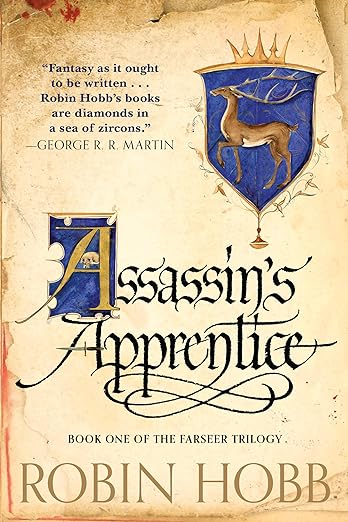
Dive into Robin Hobb’s “Assassin’s Apprentice,” where fantasy meets complexity and morality blurs. Explore how FitzChivalry Farseer, an unlikely hero with a dark skill set, reshapes our understanding of fantasy protagonists. Unpack Hobb’s intricate world of magic and politics, delving into a narrative that goes beyond good vs. evil. Discover how this groundbreaking story influences modern fantasy, paving the way for deeper character development and more nuanced storytelling in the genre.
In the often bright and valiant world of fantasy literature, Robin Hobb‘s “Assassin’s Apprentice” arrived like a shadow in the night.
With this book, Hobb didn’t just introduce readers to a new story; she introduced us to FitzChivalry Farseer – a hero as unlikely as finding a courteous goblin.
This tale of an assassin’s apprentice was a sharp turn from the usual path of swords and sorcery, taking the road less travelled – and considerably darker.
An Assassin with a Heart: Shaking Up the Hero Mold
Fitz wasn’t your typical fantasy protagonist.
He was no noble knight on a gleaming steed nor a wise wizard with a long beard and a penchant for riddles.
Instead, he was a boy with a knack for killing and a complicated moral compass.
Hobb crafted a character that was as complex as he was conflicted, bringing a depth to Fitz that went beyond the traditional good versus evil narrative.
He was a walking contradiction, a hero in a role usually reserved for villains.
Magic and Mind: A Different Kind of Power
In “Assassin’s Apprentice”, magic wasn’t just about throwing fireballs or summoning storms.
Hobb introduced the Wit and the Skill – two forms of magic that were as nuanced as they were powerful.
The Wit, a bond with animals, was considered a lowly, almost taboo form of magic, while the Skill was a prestigious, mind-influencing ability.
This reimagining of magic systems injected a fresh dose of intrigue into the fantasy genre, turning magic into a source of inner turmoil as much as external power.
Narrative Grit: The Nitty-Gritty of Royal Politics
Hobb’s narrative delved deep into the murky waters of court intrigue and politics, with all the backstabbing and power plays one might expect in a den of vipers rather than a royal court.
This focus on the political, often from the perspective of someone usually left in the shadows, gave the fantasy genre a grittier, more realistic edge.
It was like lifting a rock to see the unsightly creatures writhing underneath – fascinating, if somewhat unsettling.
Influence on Modern Fantasy: The Echoes of Fitz’s Blade
The influence of “Assassin’s Apprentice” on modern fantasy is as clear as the scars on Fitz’s soul.
The series paved the way for a more nuanced approach to character development, where heroes were allowed to be flawed, and villains occasionally sympathetic.
Hobb’s blend of personal struggle, political intrigue, and a less conventional approach to magic has left an indelible mark on the genre, inspiring authors to explore the grey areas of their characters and worlds.
The Enduring Legacy of a Reluctant Assassin
“Assassin’s Apprentice” was more than just a fantasy novel; it was a masterclass in character-driven storytelling.
Robin Hobb created a world where the line between hero and villain was as thin as a knife’s edge, and just as sharp.
In the annals of fantasy literature, FitzChivalry Farseer remains a testament to the genre’s ability to evolve, to push boundaries, and to redefine what it means to be a hero.
The echoes of Fitz’s blade, and the choices he made with it, continue to resonate in the modern fantasy landscape.