
Exploring the Complex World of Robin Hobb’s Assassin’s Apprentice

Dive into Robin Hobb’s “Assassin’s Apprentice,” where fantasy meets complexity and morality blurs. Explore how FitzChivalry Farseer, an unlikely hero with a dark skill set, reshapes our understanding of fantasy protagonists. Unpack Hobb’s intricate world of magic and politics, delving into a narrative that goes beyond good vs. evil. Discover how this groundbreaking story influences modern fantasy, paving the way for deeper character development and more nuanced storytelling in the genre.

In the often bright and valiant world of fantasy literature, Robin Hobb‘s “Assassin’s Apprentice” arrived like a shadow in the night.

With this book, Hobb didn’t just introduce readers to a new story; she introduced us to FitzChivalry Farseer – a hero as unlikely as finding a courteous goblin.

This tale of an assassin’s apprentice was a sharp turn from the usual path of swords and sorcery, taking the road less travelled – and considerably darker.
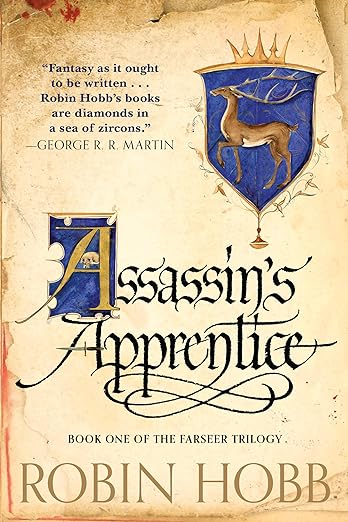
An Assassin with a Heart: Shaking Up the Hero Mold

Fitz wasn’t your typical fantasy protagonist.

He was no noble knight on a gleaming steed nor a wise wizard with a long beard and a penchant for riddles.

Instead, he was a boy with a knack for killing and a complicated moral compass.

Hobb crafted a character that was as complex as he was conflicted, bringing a depth to Fitz that went beyond the traditional good versus evil narrative.

He was a walking contradiction, a hero in a role usually reserved for villains.

Magic and Mind: A Different Kind of Power

In “Assassin’s Apprentice”, magic wasn’t just about throwing fireballs or summoning storms.

Hobb introduced the Wit and the Skill – two forms of magic that were as nuanced as they were powerful.

The Wit, a bond with animals, was considered a lowly, almost taboo form of magic, while the Skill was a prestigious, mind-influencing ability.

This reimagining of magic systems injected a fresh dose of intrigue into the fantasy genre, turning magic into a source of inner turmoil as much as external power.

Narrative Grit: The Nitty-Gritty of Royal Politics

Hobb’s narrative delved deep into the murky waters of court intrigue and politics, with all the backstabbing and power plays one might expect in a den of vipers rather than a royal court.

This focus on the political, often from the perspective of someone usually left in the shadows, gave the fantasy genre a grittier, more realistic edge.

It was like lifting a rock to see the unsightly creatures writhing underneath – fascinating, if somewhat unsettling.

Influence on Modern Fantasy: The Echoes of Fitz’s Blade

The influence of “Assassin’s Apprentice” on modern fantasy is as clear as the scars on Fitz’s soul.

The series paved the way for a more nuanced approach to character development, where heroes were allowed to be flawed, and villains occasionally sympathetic.

Hobb’s blend of personal struggle, political intrigue, and a less conventional approach to magic has left an indelible mark on the genre, inspiring authors to explore the grey areas of their characters and worlds.

The Enduring Legacy of a Reluctant Assassin

“Assassin’s Apprentice” was more than just a fantasy novel; it was a masterclass in character-driven storytelling.

Robin Hobb created a world where the line between hero and villain was as thin as a knife’s edge, and just as sharp.

In the annals of fantasy literature, FitzChivalry Farseer remains a testament to the genre’s ability to evolve, to push boundaries, and to redefine what it means to be a hero.

The echoes of Fitz’s blade, and the choices he made with it, continue to resonate in the modern fantasy landscape.

The Echoes of The Belgariad: Eddings’ Influence on Modern Fantasy

Exploring David Eddings’ ‘The Belgariad’ and its undeniable influence on modern fantasy, from ‘Game of Thrones’ to ‘Harry Potter’.

Once upon a time, as all good stories start, in the small town of Spokane, Washington, a man by the name of David Eddings put pen to paper and began to weave a tale of prophecy, magic and, most importantly, a farm boy named Garion.

A tale that, unbeknownst to him, would shape the course of modern fantasy literature.

This tale?

“The Belgariad.”

The Chosen One

Now, I know what you’re thinking. “Oh, not another Chosen One narrative.”

 Yes, I hear you, and I can only offer a shrug and a sheepish grin in response.

But if one were to dismiss Eddings’ work as just another predictable riff on the same old trope, they’d be missing out on an influential cornerstone of the genre.

“The Belgariad,” with its magical orbs, prophecies, and a cast of characters so colourful they make a bag of Skittles look positively monochrome, has had a reach far greater than it’s given credit for.

Its influence can be seen in the works of authors from across the globe, like a whisper of Spokane in every fantasy bookshop.

A Game of Thrones

Take, for instance, George R.R. Martin of “A Song of Ice and Fire” fame.

Now, Martin’s work might be a bit grimmer (read: “Red Wedding”), but dig a bit deeper and you’ll see Eddings’ fingerprints all over it.

The intricate politics, the sprawling world-building, the stark contrast of good versus evil—all hallmarks of “The Belgariad.”

Even the character of Jon Snow, the broody, duty-bound hero, echoes Garion in more ways than one (though I’ll grant you, Jon’s direwolf beats Garion’s horse in a coolness contest).

The boy who lived…

Or what about J.K. Rowling’s “Harry Potter” series?

The boy who didn’t know he was a wizard until a giant man broke down his door one day?

Smells a bit like Garion’s own journey, doesn’t it?

The parallels go beyond the surface, though; they both grapple with destiny, they both have a dark lord to defeat, and they both have a wise old mentor guiding them (no points for guessing which one has a longer beard).

Into the Cosmere

Let’s not forget Brandon Sanderson, who seems to have taken a leaf or two out of Eddings’ book.

Sanderson’s “Mistborn” series, with its complex magic system, may seem far removed from “The Belgariad,” but look closer.

The deep, diverse world and the idea of prophecy as a central plot device?

That’s all very Eddings.

Plus, there’s also the whole “humble beginnings” thing.

Vin, the street urchin turned hero of “Mistborn,” could be Garion’s long-lost sister (or at least distant cousin twice removed).

A lasting legacy

So, whether you’re a fan of the “Game of Thrones” bloodbaths, the “Harry Potter” wizarding world, or the “Mistborn” metallic magic, you’ve got a bit of “The Belgariad” in your bookshelf.

Eddings may not have reinvented the wheel (or the magic orb, as it were), but he certainly gave it a good spin.

His work stands as a testament to the impact of a well-told story, and a reminder that even the most unassuming farm boy can end up saving the world.

In the end, the influence of “The Belgariad” is a bit like Garion’s magic—it’s there, bubbling under the surface, quietly shaping the course of things.

You just have to know where to look.

And don’t worry—unlike Garion, you won’t need a grumpy old sorcerer to help you out.

Just keep an eye out for any orbs.