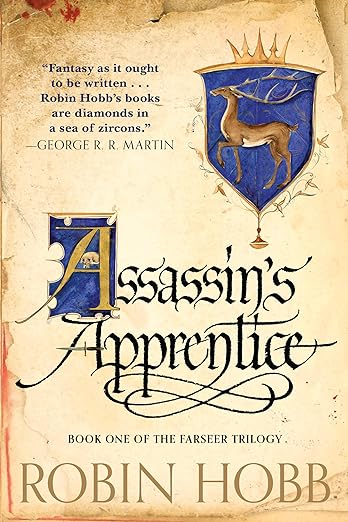
Dive into Robin Hobb’s “Assassin’s Apprentice,” where fantasy meets complexity and morality blurs. Explore how FitzChivalry Farseer, an unlikely hero with a dark skill set, reshapes our understanding of fantasy protagonists. Unpack Hobb’s intricate world of magic and politics, delving into a narrative that goes beyond good vs. evil. Discover how this groundbreaking story influences modern fantasy, paving the way for deeper character development and more nuanced storytelling in the genre.
In the often bright and valiant world of fantasy literature, Robin Hobb‘s “Assassin’s Apprentice” arrived like a shadow in the night.
With this book, Hobb didn’t just introduce readers to a new story; she introduced us to FitzChivalry Farseer – a hero as unlikely as finding a courteous goblin.
This tale of an assassin’s apprentice was a sharp turn from the usual path of swords and sorcery, taking the road less travelled – and considerably darker.
An Assassin with a Heart: Shaking Up the Hero Mold
Fitz wasn’t your typical fantasy protagonist.
He was no noble knight on a gleaming steed nor a wise wizard with a long beard and a penchant for riddles.
Instead, he was a boy with a knack for killing and a complicated moral compass.
Hobb crafted a character that was as complex as he was conflicted, bringing a depth to Fitz that went beyond the traditional good versus evil narrative.
He was a walking contradiction, a hero in a role usually reserved for villains.
Magic and Mind: A Different Kind of Power
In “Assassin’s Apprentice”, magic wasn’t just about throwing fireballs or summoning storms.
Hobb introduced the Wit and the Skill – two forms of magic that were as nuanced as they were powerful.
The Wit, a bond with animals, was considered a lowly, almost taboo form of magic, while the Skill was a prestigious, mind-influencing ability.
This reimagining of magic systems injected a fresh dose of intrigue into the fantasy genre, turning magic into a source of inner turmoil as much as external power.
Narrative Grit: The Nitty-Gritty of Royal Politics
Hobb’s narrative delved deep into the murky waters of court intrigue and politics, with all the backstabbing and power plays one might expect in a den of vipers rather than a royal court.
This focus on the political, often from the perspective of someone usually left in the shadows, gave the fantasy genre a grittier, more realistic edge.
It was like lifting a rock to see the unsightly creatures writhing underneath – fascinating, if somewhat unsettling.
Influence on Modern Fantasy: The Echoes of Fitz’s Blade
The influence of “Assassin’s Apprentice” on modern fantasy is as clear as the scars on Fitz’s soul.
The series paved the way for a more nuanced approach to character development, where heroes were allowed to be flawed, and villains occasionally sympathetic.
Hobb’s blend of personal struggle, political intrigue, and a less conventional approach to magic has left an indelible mark on the genre, inspiring authors to explore the grey areas of their characters and worlds.
The Enduring Legacy of a Reluctant Assassin
“Assassin’s Apprentice” was more than just a fantasy novel; it was a masterclass in character-driven storytelling.
Robin Hobb created a world where the line between hero and villain was as thin as a knife’s edge, and just as sharp.
In the annals of fantasy literature, FitzChivalry Farseer remains a testament to the genre’s ability to evolve, to push boundaries, and to redefine what it means to be a hero.
The echoes of Fitz’s blade, and the choices he made with it, continue to resonate in the modern fantasy landscape.
Discover the most overused tropes in fantasy fiction! From the Chosen One to the Dark Lord, explore common clichés and how to use them creatively. Avoid predictability and make your fantasy story stand out.
Welcome to the whimsical world of fantasy literature, where dragons soar, magic reigns supreme, and originality often goes on an extended holiday.
As we embark on this journey, it’s worth noting that fantasy, in its insatiable appetite for the mystical and the mythical, has developed a bit of a sweet tooth for certain narrative tropes.
These tropes are like the high street chains of the literary world – no matter where you go, there they are, serving up the same familiar fare with only the names changed to protect the not-so-innocent.
In this exploration, we’re not just skimming the surface; we’re diving headfirst into the depths of the genre’s most beloved (and berated) conventions.
From the omnipresent ‘Chosen One’, burdened with saving the world (and carrying the plot), to the ever-convenient ‘Deus ex Machina’, swooping in to tie up those pesky plot holes, we’ve got them all lined up.
Think of this as your guidebook to the well-trodden paths of fantasy fiction.
As we venture through this enchanted realm, we’ll take a gander at each trope with a discerning eye and a notepad full of snide remarks.
So, sharpen your swords (or wits, as the case may be), summon your familiars, and prepare for a tour of fantasy’s most overworked narrative devices.
Spoiler alert: it’s a journey filled with more predictability than a fortune teller’s playbook, but who knows? You might just find a dragon or two worth fighting along the way.
Behold ‘The Horde of Mooks’, a mass of nameless, faceless minions sent to their doom with the regularity of clockwork.
These poor souls are less ‘threatening adversaries’ and more ‘sword practice’.
Their sole purpose? To make our hero look good while barely breaking a sweat.
If only real problems were so easily dispatched.
9. The Big Damn Heroes: Just in the Nick of Time
And then there’s the ‘Big Damn Heroes’, a group of characters who swoop in to save the day just when all seems lost.
Their timing is impeccable, their skills unmatched, and their ability to steal the spotlight from the protagonist is downright uncanny.
Who needs a well-constructed plot when you have friends in high places?
10. The Deus ex Machina: The Lazy Writer’s Best Friend
Finally, we come to ‘The Deus ex Machina’, the literary equivalent of a magic wand wave to resolve any plot crisis.
It’s the narrative ‘get out of jail free’ card, often involving a god, a machine, or some other contrivance that comes out of nowhere.
Why bother tying up loose ends when the universe can just intervene on your behalf?
A Twist on the Tale – The Art of Subverting Tropes
These top ten most overused tropes are the threads that have been woven and re-woven into the fabric of storytelling.
But here’s the twist – these tropes are not inherently the villains of our tale.
In fact, when acknowledged and approached with a wink, they can be the secret ingredients to a rich and compelling narrative.
The key lies not in shunning these tropes but in understanding them, recognising their presence, and then, most intriguingly, playing with them.
A trope can be a foundation, a starting point from which a story can diverge into uncharted territories.
Subverting a trope, flipping it on its head, or giving it a fresh coat of paint can transform the familiar into something startlingly original.
Imagine a ‘Chosen One’ who refuses the call, a ‘Magic Sword’ that’s more trouble than it’s worth, or a ‘Damsel in Distress’ who’s the mastermind of her own kidnapping.
These twists make the narrative more than just a regurgitation of the same old stories – they turn it into a conversation with the reader, a playful dance of expectations and surprises.
In the hands of a skilful writer, these overused tropes can be the stepping stones to deeper, more meaningful storytelling.
They can add layers of complexity and humour, making the story more engaging and, dare we say, more enchanting for the reader.
It’s a delicate balance, like seasoning a dish – just enough can enhance the flavour, but too much can overwhelm it.
So, to all the aspiring fantasy writers out there, don’t shy away from these tropes.
Instead, invite them in, offer them a seat, and then tell them the story they weren’t expecting to hear.
After all, the best tales are those that feel familiar but leave us marvelling at their ingenuity.