This week I swap writing for an Adventure Week in the Lake District with Galloway’s, trying canoeing, fell climbing and sailing, including a brilliant session on a Dart catamaran.
This week’s Author Diary is a little different because I did absolutely no writing.
Instead, I spent the week at Coniston in the Lake District on an Adventure Week organised by Galloway’s, a charity supporting blind and visually impaired people.
It was a brilliant week packed with canoeing, sailing, fell climbing and plenty of other activities.
One of the best parts was getting to meet other blind and visually impaired people, hearing how they approach different challenges, and picking up ideas about ways of doing things that I hadn’t considered before.
The highlight for me was definitely the sailing. I especially loved getting out on a Dart catamaran, which was enormous fun. It’s something I’d really like to do more of, so I’m now looking into what sailing opportunities might be available locally.
No word count this week, then, but plenty of new experiences, new people and perhaps the start of a new hobby.
This week I prepare RAF Dragon Corps Book 3 for my editor, begin drafting The Hammer and the Crown, share my thoughts on Soulsmith and decide to take a much-needed break.
This week I’ve been getting RAF Dragon Corps Book 3 ready to send to my editor.
After finishing the draft, I’ve been working through the manuscript one last time, checking that everything is in place before handing it over.
I’ve also started drafting The Hammer and the Crown, the fourth book in my Ravenglass Legends series. It feels good to be back with Ragnar and Maja and moving forward with the next stage of the story.
On the reading front, I’m halfway through Soulsmith by Will Wight. I really enjoyed Unsouled, but I’ve found parts of the second book harder to follow. I’m going to keep reading for now, as so many readers love the Cradle series, and I’m hoping the story finds its footing again.
I also talk about feeling increasingly tired. I haven’t had a proper break since our trip to Rome in May, so I’ve decided to take next week off and give myself some time to recharge.
What if your honesty, diligence, and loyalty made you part of the problem? A look at institutions, complicity, and the central question behind the fantasy spy thriller Silent Watcher.
One of the questions that sits underneath Silent Watcher is surprisingly simple: What if you’re part of the problem?
Not the villain. Not the mastermind. Not the person giving the orders. Just someone doing their job.
It’s an uncomfortable question because most of us naturally imagine we’d be the exception.
When we read about corruption, institutional failures, or historical injustices, we picture ourselves as the person who would have spotted it. The whistleblower. The dissenter. The person who refused to go along with it.
Very few people imagine themselves as the person quietly helping the system function.
Yet that’s where most people live.
Not because they’re bad people.
Because most institutions are built from ordinary people doing work they believe matters.
The uncomfortable truth is that systems rarely depend on villains.
They depend on competent people. People who show up every day and do their jobs well.
Most of the time, those people don’t see the whole picture.
The person filling in the form doesn’t know where the form goes next.
The person writing the report doesn’t know how it will be used.
The person recording an event doesn’t know who benefits from the record.
Everyone sees a small part of the machine.
That’s what makes these systems so effective.
The people inside them don’t need to be wicked.
They just need to keep doing their jobs.
What interested me most wasn’t the discovery of corruption.
It was what comes afterwards.
Imagine discovering that you helped something harmful happen.
Now imagine discovering that your best qualities were the reason.
Your strengths. Your honesty. Your diligence.
The institution didn’t need to exploit your flaws.
It relied on your virtues.
That’s a much harder thing to live with.
It’s one thing to discover you made a mistake. It’s another to discover that the qualities you’re proudest of were exactly what made you useful.
When I started writing Silent Watcher, I knew the protagonist couldn’t be cynical.
She had to believe.
Anselma has spent twenty years serving an organisation she genuinely respects. She believes in its mission. She believes in its values. She believes she’s helping preserve the truth.
She’s good at her job.
She’s proud of her work.
She’s convinced she’s one of the good people.
That’s what makes the story work.
A cynic expects corruption. A believer doesn’t.
When a cynic discovers a lie, they shrug.
When a believer discovers a lie, the discovery threatens their entire sense of self.
Because suddenly the question isn’t whether the institution can be trusted.
It’s whether they can trust themselves.
I won’t spoil where Anselma’s story goes. But I will say this was the question I kept returning to while writing the book:
If you were diligent, decent, honest, and loyal, would you have seen what was happening?
Or would those very qualities have made you useful to the system?
I’d like to think I’d have noticed.
I’d like to think I’d have asked the difficult questions.
Most of us would.
But that’s exactly why I find the question interesting.
I’m not sure any of us really know the answer.
And I suspect admitting that uncertainty is probably the most honest place to start.
Silent Watcher is a standalone fantasy spy thriller about a woman who serves the truth inside an institution that has learned to manufacture it.
For readers of Seth Dickinson, John le Carré, and K. J. Parker.
This week: I finished RAF Dragon Corps Book 3, began The Hammer and the Crown, completed two long-abandoned stories, and enjoyed Unsouled by Will Wight.
This week I wrapped up my draft of RAF Dragon Corps Book 3.
I’ll be letting it rest for a while before coming back with fresh eyes, but it’s always a great feeling to reach the end of another novel.
With that finished, I’ve started outlining—and even written the first chapter of—The Hammer and the Crown, the fifth book in my Ravenglass Legends series. It feels good to be returning to Ragnar and Maja.
I also decided to tackle a couple of older projects as part of my ongoing audit of unfinished work.
I completed Family of the Wasteland, a novella I originally drafted back in 2017. It’s now available exclusively on my Patreon, where even free members can download and read it.
I also finished Threads of Wolfsbane, a Ravenglass Legends prequel starring Maja. That story will be landing on Patreon this weekend, and I’m pleased to finally cross another long-standing project off the list.
On the reading front, I’ve been reading Unsouled by Will Wight and thoroughly enjoyed it.
It’s my first real taste of progression fantasy. I’m still not entirely sure where the genre boundaries lie, but the focus on steadily developing the protagonist’s abilities gave it an almost anime-like feel.
A really entertaining read, and I’m looking forward to continuing the series.
Looking for the best revenge fantasy books? These eight dark fantasy tales begin with loss, betrayal or murder, then grow into something far bigger.
The best revenge fantasy books begin with one wound.
A murdered parent. A burned home. A betrayal by someone who should have been trusted. The protagonist sets out after one person, one name, one debt to settle.
For a while, that seems to be the whole story.
Then the trail opens up. The killer was hired. The person who paid them answers to somebody higher. A private act of revenge becomes a conspiracy, a war, or a fight for control of an entire kingdom.
That is what I love about revenge fantasy.
Revenge gets a character moving. It gives them a purpose when grief has taken everything else away. But it rarely stays simple. The deeper they go, the more they learn that the world is bigger, darker and more complicated than the loss that first set them on the road.
The old template is The Count of Monte Cristo. Edmond Dantès begins as an innocent man destroyed by betrayal, but the real story is not whether he gets revenge. It is what revenge turns him into.
Fantasy has been using that formula ever since.
Here are eight revenge fantasy books that start with a single wound and refuse to remain small.
Best Served Cold by Joe Abercrombie
For revenge fantasy stripped down to its sharpest form, start here.
Monza Murcatto is the most feared mercenary captain in Styria until the duke she serves betrays her, murders her brother and throws her from a balcony. She survives, broken in body and changed in spirit, with seven names on her list.
What follows is a bloody journey through a country built on poison, politics and betrayal.
Abercrombie understands that revenge is never clean. Every name Monza crosses off costs her something. Every victory makes the rest of her world more dangerous. Her private vendetta soon becomes tangled up in a conflict that threatens cities, armies and nations.
The dialogue is sharp. The violence is ugly. The characters are compromised in ways that make them hard to trust and impossible to ignore.
Read this if you want revenge fantasy that is brutal, clever and morally murky. It earns its grimdark reputation.
The immortal ruler of the Final Empire took everything from him in the brutal slave pits where people are worked until they die. Kelsier survives, discovers extraordinary magical abilities, and comes out with a smile and a plan to bring the whole system down.
But this is not revenge with a dagger in an alleyway.
It is a heist. A rebellion. A plan to overthrow an empire that has stood for a thousand years. At its heart is Vin, a young street thief who becomes far more important than Kelsier first expects.
What begins as one man’s rage becomes a fight for hope.
Sanderson writes with clarity and momentum. The magic system is easy to understand but gives the action real weight, and the story keeps widening as it goes.
Read Mistborn if you want revenge fantasy that turns into revolution, adventure and something unexpectedly hopeful.
Rin claws her way out of poverty and into the Empire’s most prestigious military academy.
At first, The Poppy War has the shape of a school fantasy. There are rival students, brutal lessons, prejudice and a protagonist trying to prove she belongs in a world determined to keep her out.
Then war comes.
Rin’s anger, humiliation and need to prove herself become something much bigger once she is given real power. What begins as a personal struggle turns into a devastating story about war, atrocity and the terrible temptation of revenge.
Kuang does not make vengeance easy to cheer for. She forces you to sit with the consequences of it.
This is a hard book in places. It deals with extreme violence and horrific events. But for readers who want a revenge story that asks what happens when rage is handed the power to destroy nations, it is one of the strongest modern fantasy novels in the field.
By the time the story begins, he is fourteen years old, leading a band of cutthroats through a broken empire and willing to do terrible things to get what he wants.
The murder of Jorg’s family is the wound at the centre of the story. But his ambitions quickly grow beyond the people directly responsible. Revenge becomes a route towards power, then a route towards the throne itself.
Jorg is not a hero in any straightforward sense. He is cruel, clever and often deeply unpleasant.
That is the point.
Mark Lawrence writes an antihero who does not ask to be forgiven. The book is bleak, violent and darkly funny, with a ruined world gradually revealing more beneath the surface.
Read this if you want revenge fantasy with an unapologetically ruthless protagonist.
This is science fiction rather than traditional fantasy, but it belongs on this list.
Darrow is a Red, part of the lowest caste in a rigid society built on Mars. He believes he is helping prepare the planet for future generations. Then the ruling class murders his wife, and he learns the truth.
The surface has been habitable for centuries. His people have been enslaved by a lie.
Darrow’s grief becomes a mission. He is remade, sent into the world of the ruling Golds, and forced to survive a brutal proving ground designed to turn young people into leaders, killers and tyrants.
One woman’s death becomes a revolution against an entire civilisation.
The pace is relentless. The politics are ruthless. The stakes rise fast and keep rising.
Read Red Rising if you want a revenge story that becomes a war for the future of the world.
Jemisin begins with a woman whose husband has murdered their son and taken their daughter.
On the same day, the world itself begins to fall apart.
Essun sets out across a dying continent to find the man who wronged her and the child he has taken. That search leads into one of the most original fantasy worlds of recent years, a place shaped by catastrophe, oppression and the constant threat of destruction.
This is revenge folded into grief, apocalypse and a furious reckoning with power.
The personal story and the wider crisis are never separate. Essun’s loss is part of something far larger, and the structure of the novel reveals that connection with real force.
The prose is assured. The worldbuilding is unlike anything else. The book asks a great deal from the reader, but it pays that attention back.
Read The Fifth Season if you want revenge fantasy with literary weight and an uncompromising vision.
Sometimes the wound is inflicted on a family. Sometimes revenge becomes a war between clans.
In Janloon, jade gives power to those strong enough to wield it, and two rival families maintain an uneasy grip on the city. When that balance begins to break, the Kaul family is pulled into a conflict that costs them blood, loyalty and certainty.
What begins with insult, pride and violent reprisals becomes a fight for the future of an entire city.
Fonda Lee writes this with the energy of a great crime saga. Family obligations, political pressure, personal ambition and old grudges all tighten together until nobody can step away without losing something important.
Read Jade City if you want revenge fantasy with the sweep of a family epic and the tension of organised crime.
Soren is a sculptor’s apprentice in a quiet fishing town. He dreams of a bigger life and spends his days arguing with his best friend Alaric about whose work is worse.
Then he comes home and finds his father murdered.
Nothing has been stolen. The killer wanted something else, and nobody can tell Soren what.
Soren and Alaric set out to find the man responsible. Their search leads to rumours of an assassins’ guild, the kind of organisation the magistrates insist does not exist.
That is where the story grows.
The trail takes them far from home and into a remote training compound where recruits are tested against one another. They learn how to fight, hide, track, survive and kill. The only way out is to pass.
Soren begins with one question: who killed my father, and why?
But the deeper he goes, the harder question becomes this: what are you willing to become to get the answer?
I wanted the friendship between Soren and Alaric to sit at the heart of the story. They begin as two ordinary lads in over their heads, and their loyalty is tested when the Guild starts asking them to cross lines they cannot uncross.
It is fast-paced, friendship-led assassin fantasy with deadly training, wyverns, dark secrets and little romance.
Grief, rage and the refusal to let injustice stand are powerful reasons to act. They get characters moving when fear, caution or common sense might otherwise keep them at home.
But the best revenge fantasy books know that revenge is only the beginning.
It is a door.
Walk through it, and the world on the other side is bigger than your grief. The person you wanted to punish was only the nearest part of something much larger. The real cost is not always paid by your enemy.
Often, it is paid by you.
That is what makes these stories last. They are not simply about whether someone gets what they deserve. They are about what revenge does to the person who carries it.
Where to Start With Revenge Fantasy
For grimdark revenge at its finest, start with Best Served Cold.
For revenge that grows into rebellion and hope, choose Mistborn: The Final Empire.
For a devastating story about war and vengeance, read The Poppy War.
For an antihero you may not like but will struggle to forget, try Prince of Thorns.
And for a fast-paced assassin fantasy about friendship, grief and a murdered father’s unanswered questions, pick up Guild of Assassins.
Follow the wound.
It rarely leads where you expect.
Claim Your Free Copy of Guild Assassin
Behind every perfect assassination lies an imperfect conscience.
In a world where death is another transaction, Soren executes contracts with perfect precision.
Wielding a ravenglass dagger that hungers for essence and leaves only ash, he moves through the shadowy politics of Nordturm and beyond.
But when his targets begin to reflect the humanity he has tried to bury, the Guild’s most reliable assassin faces a different kind of contract: one written on his conscience.
From political schemes to quiet acts of rebellion, these dark fantasy tales examine the cost of loyalty and the unexpected mercy found in darkness.
This week: Five of Swords goes to my editor, I proof-listen to The Ravenglass Throne audiobook, and audit more than 15 unfinished novels from the past decade.
This week I finished Five of Swords and sent the manuscript off to my editor, marking another milestone in The Ravenglass Chronicles.
I also completed a proof-listen of The Ravenglass Throne: Parts 5–8 audiobook, and once again Emmy Coates has done an outstanding job bringing the story to life. I can’t wait for listeners to hear it.
One of the more interesting things I did this week was a full audit of all my open writing projects. The results surprised even me: more than 15 novels, around 10 novellas, and several short stories in various stages of completion—including ideas dating back more than a decade.
Some of them still excite me and will definitely get finished. Others have probably had their day. It was a fascinating exercise in taking stock and deciding which stories are still worth telling.
Why I wrote a fantasy spy thriller about records, archives, and institutional power. A look at how paperwork, documentation, and official narratives inspired Silent Watcher.
When people hear “fantasy spy novel”, they tend to picture assassins, coded messages, secret meetings, and people passing sealed letters in dark alleyways.
There’s some of that in Silent Watcher.
But the thing that ended up fascinating me most wasn’t any of the spycraft.
Reports. Archives.Records. The mundane machinery by which institutions decide what officially happened.
And possibly one of the most frightening.
Think about how much of your understanding of reality depends on records. Who owns a house. Who owes a debt. Who was born. Who died. Whether something happened at all.
Most of us don’t rely on memory for those things. We rely on documentation.
A functioning society more or less depends on that.
You can’t run a country on competing recollections. So we trust the record.
The problem is that whoever controls the record controls something very close to reality itself.
That’s not a fantasy concept. That’s just how institutions work.
The version that gets stamped, filed, and archived almost always beats the version that exists only in someone’s memory.
The report becomes the truth.
Or at least the official version of it.
One of the things that interests me about institutions is that they can produce terrible outcomes without containing a single obviously evil person.
Fantasy often gives us a Dark Lord. Or a tyrant. Or a corrupt noble.
A person we can point at and blame.
Real life is often messier. A witness statement gets revised. A report gets adjusted. A death is recorded as an accident because accident is the category that closes the file.
Each decision seems small. Each decision seems reasonable. Everyone involved can honestly say they’re simply doing their job.
Yet by the end of the process, the official record describes a reality that never actually happened.
That’s what unsettles me.
Not the lie itself.
The fact that nobody involved necessarily thinks of themselves as lying.
That idea eventually became Silent Watcher.
The protagonist, Anselma, belongs to an order whose entire purpose is to observe and record events.
Her reports become the official account.
Her authority depends on documentation being trustworthy.
Which makes her the worst possible person to discover that the records may not be reliable.
She arrives in a quiet town to investigate the death of another Watcher.
The official report says everything is settled.
The evidence suggests otherwise.
Then she discovers reports in her own handwriting, carrying her own signature, authorising actions she has no memory of taking.
At that point, the investigation stops being about a dead colleague.
It becomes a question of whether she can trust anything at all.
Including herself.
One of the things fantasy does particularly well is take an ordinary fear and make it impossible to ignore.
Most of us have experienced that moment when the official version of events doesn’t quite match what we know happened.
Most of us have dealt with a form, a database, or a decision that suddenly feels more real than our own experience.
Fantasy lets you turn that feeling into the central conflict.
It lets you build a world where the record really is stronger than memory.
Where the paperwork can come for you.
Where the truth isn’t hidden.
It’s been replaced.
That’s the idea that sat underneath Silent Watcher from the beginning.
A document.
And the uncomfortable possibility that the document is wrong.
Silent Watcher is a standalone fantasy spy thriller about secrets, deception, and institutional betrayal.
For readers of Seth Dickinson, John le Carré, and K. J. Parker.
This week: I finished the draft of Five of Swords, outlined Six of Swords, and planned a new Black Death apocalyptic thriller set in the UK.
This week I’ve been focused on bringing Five of Swords to the finish line.
The third draft is now complete! Before it heads off to my editor, I’ll do one final read-through to catch any lingering issues and make sure everything hangs together.
Looking ahead, I’ve also finished outlining Six of Swords, so I’m ready to keep the momentum going with The Ravenglass Chronicles.
One unexpected development came from looking through some of my old, unused book covers. That sparked an idea to return to the world of Black Death.
I’ve now outlined a second novel—an apocalyptic thriller set in the UK—and I’m excited by the possibilities.
It’s still early days, but it reminded me how ideas can come from the most unexpected places.
Looking for assassin academy books? Here are seven fantasy novels packed with secret schools, deadly training, rival recruits and hard choices.
There is a simple promise at the heart of an assassin academy story, and it gets me every time.
Take an ordinary young person. Put them somewhere built to turn them into a weapon. Then make them live with what that costs.
The lessons are only part of it. Blades, poisons, stealth, survival, reading people, and keeping calm when every instinct tells you to run. The real question is what happens when the training stops being theoretical.
A recruit can walk through the gates knowing nothing about killing. By the end, they may be able to take a life without hesitation. The moment that matters comes somewhere in between: the first time they are ordered to cross a line they cannot uncross.
What makes an assassin academy book work?
The best assassin schools feel like worlds in miniature.
They have rules, hierarchies, secrets and punishments. There are masters who know exactly how to make a student stronger, and may not care whether that student survives the process.
There are rival recruits too. A room full of people learning how to kill was never going to be a safe place to make friends.
Most importantly, there has to be a cost. These stories work when the training changes the characters in ways they did not expect. Killing cannot just be another skill to tick off a list. It has to leave a mark.
Here are seven assassin academy books for readers who want dangerous schools, rival recruits, hard choices and characters changed by what they learn.
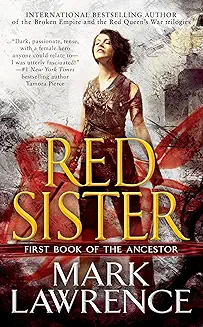
At the Convent of Sweet Mercy, young girls are trained to become killers. Mark Lawrence makes the promise early: it takes an army to bring down one of the nuns the convent produces.
Nona Grey arrives bloodstained and condemned, taken from the gallows and given a place among girls who will become sisters, rivals and enemies. She learns blade work, poison, combat and stranger arts, while the wider world slowly begins to close in around her.
This is a patient book. It takes its time with the school, the friendships and the dangers beneath the surface.
Read Red Sisterfor fierce friendships, a strong sense of place, and an assassin school that feels old, secretive and genuinely dangerous.
Mia Corvere wants revenge. To get it, she enters the Red Church, a school for assassins devoted to a goddess of murder.
The training is brutal. The other acolytes are dangerous. Failure is not a disappointing grade or a stern word from a teacher. It can mean death.
Nevernight sits at the darker end of assassin fantasy. The prose is stylised, the violence is bloody, and the school itself is built around the knowledge that not everyone who enters will leave alive.
There is romance and adult content, so this is very much aimed at older readers. But for those who want assassin training with attitude, bloodshed and sharp edges, it delivers.
Celaena Sardothien is already a feared assassin when the story begins. She has survived a year in the salt mines and is offered one chance at freedom: win a competition against other killers.
The academy element is looser here than in the other books on this list. This is more trial by ordeal than classroom training. Still, the appeal is familiar: a deadly young woman, a brutal proving ground, and rivals who would be pleased to see her fail.
The series grows into something bigger, bringing in court politics, war, magic and romance. But the early books offer an accessible starting point for readers who want a confident heroine and plenty of forward momentum.
Some learn in secret, one lesson at a time, from a man who appears in the shadows and leaves before dawn.
FitzChivalry Farseer is the royal bastard nobody quite knows what to do with. He is trained to serve the crown as its hidden knife, while growing up among people who love him, need him, use him and place him in danger.
Robin Hobb is less interested in flashy training sequences than in what this life does to Fitz. The assassin work matters, but so do loneliness, loyalty, friendship and the weight of being used for a purpose he did not choose.
For readers who want emotional depth, difficult relationships and a protagonist who pays for every lesson, Assassin’s Apprentice remains one of the greats.
Azoth is a guild rat trying to survive the gutters of a brutal city. When he manages to become the apprentice of Durzo Blint, the deadliest wetboy alive, he gets exactly what he asked for.
It is not a school in the traditional sense. There are no classrooms or fellow pupils. But the apprenticeship is central: Azoth is taught how to kill, how to lie, how to endure pain, and how to survive a world that values people only for what they can do.
Brent Weeks writes with pace. The book moves quickly, the world is harsh from the beginning, and the relationship between Azoth and Durzo gives the story its heart.
This is a good choice for readers who want grit, action and a hard-edged mentor-and-apprentice story.
Grave Mercy takes the assassin academy idea and places it in a historical setting.
Ismae escapes a brutal marriage and finds refuge in the convent of St Mortain. There, she is trained in poisons, blades, seduction and the service of the old god of death.
Set against the political turmoil of medieval Brittany, the book blends court intrigue with a deadly education. The training matters, but so do Ismae’s choices about duty, faith and what it means to serve death.
This is a strong pick for readers who want assassin nuns, historical fantasy, and a romance that has room to breathe without taking over the whole story.
Soren is a sculptor’s apprentice in a quiet fishing town until he finds his father murdered in their home. Hunting the killer with his best friend Alaric leads him towards a guild neither of them was meant to find.
Before long, the pair are sent to a remote training compound where recruits learn to fight, hide, track, survive and kill. The masters test them against one another, and there is no easy way back to the lives they knew.
Soren and Alaric enter this world together, and their loyalty is tested as the training grows harsher and the guild begins asking more of them.
It is a fast-paced assassin fantasy with banter, deadly recruits, wyverns and no romance. The training is the spine of the book. The price of that training is the point.
For slow-burn worldbuilding and fierce friendships, start with Red Sister.
For something darker and more savage, choose Nevernight.
For character work and emotional weight, read Assassin’s Apprentice.
For fast-paced assassin training, friendship and a guild with no safe exit, try Guild of Assassins.
Every assassin academy story makes the same promise. Someone enters as one person and leaves as another.
The question is what they had to become to survive.
Claim Your Free Copy of Guild Assassin
Behind every perfect assassination lies an imperfect conscience.
In a world where death is another transaction, Soren executes contracts with perfect precision.
Wielding a ravenglass dagger that hungers for essence and leaves only ash, he moves through the shadowy politics of Nordturm and beyond.
But when his targets begin to reflect the humanity he has tried to bury, the Guild’s most reliable assassin faces a different kind of contract: one written on his conscience.
From political schemes to quiet acts of rebellion, these dark fantasy tales examine the cost of loyalty and the unexpected mercy found in darkness.
This week: I reach the midpoint of Five of Swords, continue writing RAF Dragon Corps Book 3, and restart the Ray Bradbury Reading Challenge.
This week I reached the midpoint of Five of Swords as I continue writing the next instalment of The Ravenglass Chronicles.
I’ve also carried on writing RAF Dragon Corps Book 3, returning to the skies over Britain during the Battle of Britain.
Outside of writing, I’ve restarted the Ray Bradbury Reading Challenge. The idea is simple: read one short story, one poem, and one piece of non-fiction every day.
I’d forgotten just how rewarding the habit is. It’s a great way to keep the creative well topped up and discover voices and ideas I might otherwise have missed.
A productive week of writing, reading, and getting back into good creative habits.